

Nervous System Regulation: What It Is and How to Support It
Nervous system regulation is your body’s ability to ramp up when something demands it and come back down afterward. It is a cascade of physiological responses that reduces heightened arousal and increases calm during distress. You can support it with breathing, movement, sleep, connection and, for some people, professional care. Supplements may play a small supporting role, but they are not a shortcut. This guide explains how the system works, how to spot when it is struggling, what helps, how long it takes, and how to evaluate a nervous system supplement before you buy one.
TL;DR
- Regulation means moving flexibly between alert and calm. It is a skill and a state, not a switch you flip once.
- The most reliable tools are unglamorous: slow breathing, regular sleep, movement, food, and people you trust.
- Supplement evidence is thin and uneven. Even well-studied ones like ashwagandha come with open questions on long-term safety.
- Persistent worry, panic, or symptoms that disrupt daily life call for a clinician, not a product.
- Talk to a healthcare provider before starting any supplement, especially if you take medication.
Table of Contents
- What nervous system regulation actually means
- Signs your nervous system is struggling to settle
- What helps in the moment
- What helps over time
- How long does it take?
- When it is time to get professional help
- Do nervous system supplements help?
- Our perspective on supporting the nervous system
- Where PRESENCE fits
- A practical way to start
- FAQ
- Sources
What nervous system regulation actually means
Your autonomic nervous system runs the processes you do not consciously control: heart rate, breathing rate, digestion. It has two main branches. The sympathetic branch raises arousal so you can respond to a threat. The parasympathetic branch deactivates those processes once danger has passed, which is why it is often called the brake, or the “rest and digest” side.
A second, slower system joins in. The hypothalamic-pituitary-adrenal (HPA) axis works alongside the autonomic nervous system to produce a slower, hormonal stress response. That is why a stressful morning can leave you wired for hours after the actual trigger is gone.
A well-regulated system is not one that never gets activated. It is one that activates in proportion to the demand and recovers afterward. A hard presentation should raise your pulse. What matters is whether you can settle by evening.
A note on the wellness language
“Regulate your nervous system” has become a catch-all phrase online, and some of it is oversold. Breathing exercises will not erase trauma, and no supplement will rewire your stress response overnight. The useful version of the idea is modest and practical: give your body the conditions and cues it needs to downshift, and get help when that is not enough.
Signs your nervous system is struggling to settle
“Dysregulation” is not a formal diagnosis. It is a shorthand for sympathetic and parasympathetic activity becoming imbalanced, which can show up physically or emotionally as insomnia, anxiety, moodiness, agitation, and digestive issues.
The National Institute of Mental Health (NIMH) lists signs that overlap with this picture, including excessive worry that is hard to control, feeling on edge or restless, trouble relaxing or concentrating, irritability, fatigue, sleep problems, muscle tension, trembling, sweating, lightheadedness and shortness of breath. Many of these have other causes, which is one more reason not to self-diagnose.
A useful distinction from NIMH: stress is a response to an external cause, while anxiety can persist even without a current threat. If you feel keyed up only during a brutal deadline week, that is a stress response doing its job. If the feeling lingers with no obvious trigger, it deserves more attention.
Too revved up, or too flat
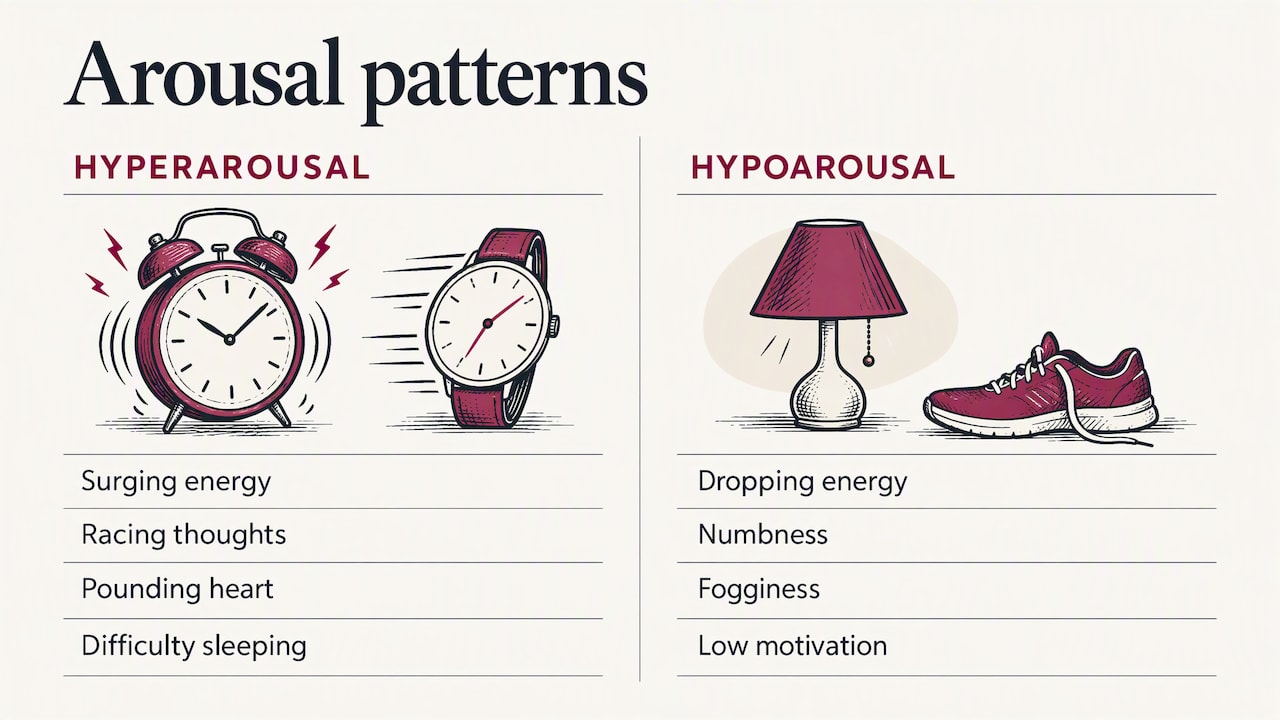
People often describe two patterns. In hyperarousal, energy surges: racing thoughts, a pounding heart, difficulty sleeping. In hypoarousal, energy drops: numbness, fogginess, low motivation. Both can be part of the same overloaded system. The Cleveland Clinic describes hyperarousal and its short-term relief and longer-term management, and the tools below mostly target the revved-up side, which is what most readers ask about.
What helps in the moment
When your body is flooded, you want something fast and physical. Thinking your way out rarely works because the thinking part of the brain is not running the show. The evidence-based advice is plain.
- Breathe slowly through your nose. The Cleveland Clinic lists slow nasal breathing, music you find calming, talking with a trusted person, a short walk, and a familiar calming scent among techniques that may reduce acute nervousness.
- Use strong sensory input. For short-term hyperarousal, the same clinic suggests a sour candy or mint, a cold drink, or a cool washcloth or ice pack on the face, neck or wrist, or a cool shower.
- Move. A short walk or some stretching gives the stress response somewhere to go. The CDC recommends breathing and relaxation, walking or stretching, and social connection.
- Cut input. The same CDC page suggests reducing news and social media exposure when worry is high.
A practical example: you finish a tense call and notice your jaw is tight and your thoughts are racing. Step away from the screen, breathe in through your nose for a count of four and out for six, and walk to refill your water. That takes three minutes and uses three of the tools above. For more situations like this, see our guide on how to remain calm under pressure.
What helps over time
In-the-moment tools manage spikes. Capacity, meaning how much load you can carry before tipping over, builds through habits. NIMH’s list of coping options reads like a checklist of basics: journaling, deep breathing or visualization, mindfulness, exercise, healthy regular meals, a consistent sleep routine, avoiding excess caffeine, challenging unhelpful thoughts, and reaching out to supportive friends or family.
The University of Maryland Medical System adds diaphragmatic breathing, progressive muscle relaxation, mindfulness, physical activity, and consistent daily routines that provide safety cues. Predictability matters more than people expect. A steady wake time, regular meals, and a wind-down routine tell your body it is safe.
How strong is the evidence for relaxation techniques?
National Center for Complementary and Integrative Health (NCCIH) summaries give a measured picture. A 2017 meta-analysis of 24 studies with 484 people found heart-rate-variability biofeedback helpful for self-reported stress and anxiety, and a 2019 review of three studies with 880 people found preliminary evidence that diaphragmatic breathing may reduce stress. “Preliminary” is the key word.
NCCIH also cautions that evidence varies by condition. A 2018 meta-analysis of 50 studies with 2,801 people found relaxation therapy less effective than cognitive behavioral therapy for PTSD and obsessive-compulsive disorder, with limits in study quality. Relaxation practice is a good foundation, not a replacement for treatment when a condition is present.
A simple weekly baseline
| Area | A realistic starting target |
|---|---|
| Breathing | 5 minutes of slow breathing once or twice a day |
| Movement | A short walk most days, plus whatever exercise you enjoy |
| Sleep | The same wake time every day, a wind-down routine |
| Food and caffeine | Regular meals, and watch your second and third coffee |
| People | One real conversation a day with someone you trust |
These are our practical suggestions built on the guidance above, not a clinical prescription. Start with one row, not five.
How long does it take?
The honest answer is that it depends on what is driving the dysregulation, how long it has been going on, and what support you have. Medical-system guidance describes the process only in general terms: it takes time, patience, and persistence. Any article that promises a specific number of days is guessing.
What you can expect is a pattern. Breathing and sensory tools often change how you feel within minutes. Sleep and routine changes tend to take longer to show up. Deeper changes, such as recovering from long-term burnout, are measured in weeks to months and often need support. If you are running on fumes, our plan to recover from mental exhaustion covers the pacing in more detail.
When it is time to get professional help
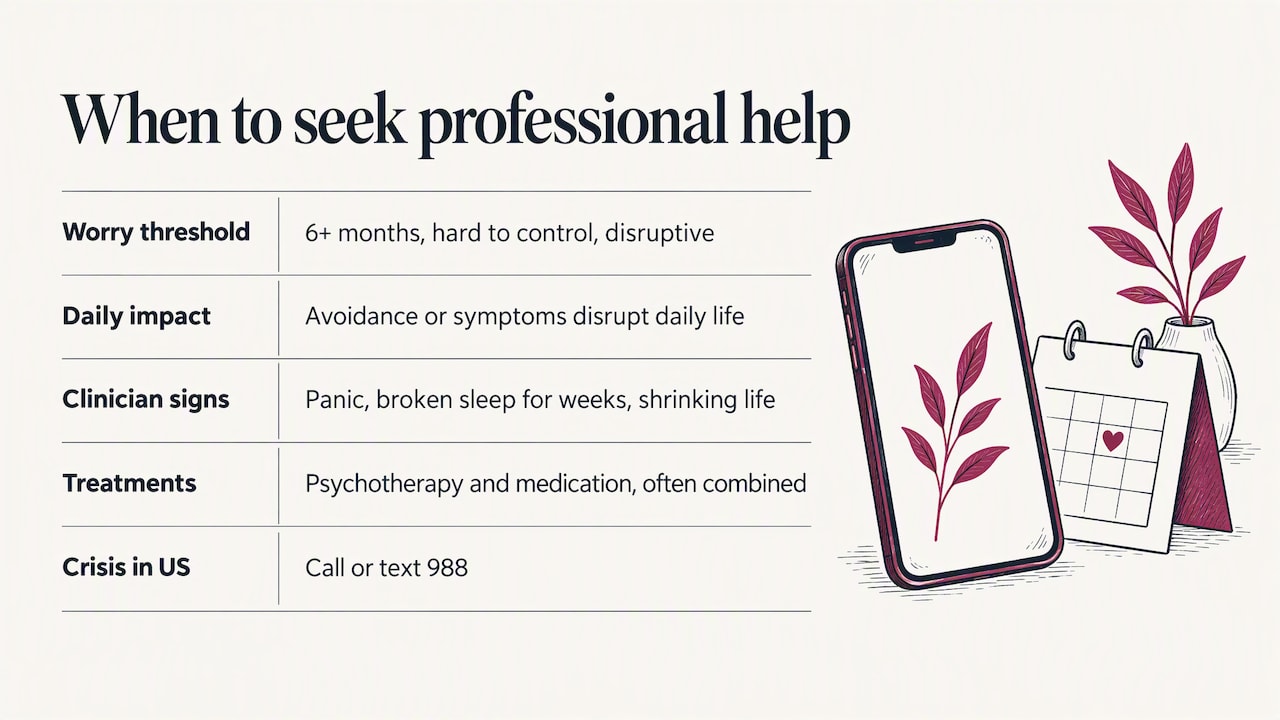
Self-regulation has limits. The CDC says worry that lasts six months or longer, is hard to control, and interferes with work, school or relationships may indicate an anxiety disorder, and it recommends professional help when worry persists. NIMH adds that symptoms that interfere with daily life, cause avoidance, or seem always present may warrant professional help, and that psychotherapy and medication are the two main treatments for anxiety, often used in combination.
See a primary care clinician, psychiatrist, or licensed therapist if you have panic attacks, if sleep has been broken for weeks, or if avoidance is shrinking your life. If you are in emotional crisis or having thoughts of self-harm, call or text 988 in the United States.
Medication is a conversation for a prescriber. Some people ask about fast-acting options such as propranolol for anxiety, where the evidence is limited and the decision belongs in an evaluation, not an online cart.
Do nervous system supplements help?
This is where marketing runs far ahead of science. Searches such as “supplements for nervous system support” return everything from vitamins to herbal extracts to products with unclear contents. Here is what authoritative sources actually say.
Ashwagandha
The NIH Office of Dietary Supplements says ashwagandha extracts might help reduce stress and anxiety, but more research is needed and long-term safety is unclear. The studies it describes lasted about 6 to 8 weeks. The same page notes possible side effects like upset stomach or drowsiness, a link to liver injury in some people, and potential interactions with medications for thyroid disorders, diabetes, high blood pressure and immune suppression.
Melatonin
Melatonin may help with sleep-onset latency, but NCCIH notes that clinical guidelines recommended against using it to treat chronic insomnia because the evidence was insufficient. The same page cites a 2023 study in which 22 of 25 over-the-counter melatonin gummy products were inaccurately labeled, with some containing almost 3.5 times the labeled amount.
That last point is the real lesson: with supplements, what is on the label and what is in the bottle can differ.
The regulatory reality
The FDA states that dietary supplements are not approved by the government for safety and efficacy before marketing, so research on the product and a conversation with a healthcare provider matter. The risk is not hypothetical. The FDA has warned that certain tianeptine products, including one brand sold as a mood or focus aid, may contain unlisted harmful ingredients and have been linked to seizures, loss of consciousness, and death.
A checklist before you buy
- Talk to a healthcare provider first, especially if you take prescription medication or are pregnant, nursing, or managing a medical condition. The FDA’s guidance is to investigate possible interactions and be skeptical of claims that sound too good to be true.
- Read the full ingredient list and the amount of each ingredient, not just the front of the bottle.
- Be wary of “miracle” language, instant cures, or products that will not say what is inside.
- Give any change a fair trial and track it: sleep, mood, focus, side effects.
- Stop and call a clinician if you notice unexpected symptoms.
For a broader look at risks and combinations, read our guide to nootropics side effects, and if you are new to the category, safe nootropics for beginners is a good start.
Our perspective on supporting the nervous system
We started from a frustration with the usual nootropic playbook. Many products lean on harsh stimulants: they can make you feel sharp for a few hours, and then you pay for it with jitters, a crash, or worse sleep. If your nervous system is already overtaxed, pushing harder on it is the wrong direction.
So we built PRESENCE around a restorative idea instead. The goal is to nurture the nervous system with carefully selected ingredients that support neurotransmitter health and resilience to nervous system stress, so that clarity, emotional balance and social ease can develop over time. We think of it as supporting capacity, not borrowing energy.
We are also clear about what a capsule cannot do. It does not replace sleep, breathing, movement, therapy, or medical care. The people who get the most from any supplement are the ones who treat it as one layer on top of sound habits. If you want to go deeper on our thinking, read nervous system support as a foundation for high performance and our piece on which nootropics work best for anxiety without sedation.
— Calvin
Where PRESENCE fits
PRESENCE is a restorative nootropic in capsule form, made for people who want mental clarity, emotional balance and stress resilience without leaning on harsh stimulants. It is designed to work alongside the habits above, with its effects building over time rather than spiking and fading. It is available as a one-time purchase or a monthly subscription, from $42 per month.
If that sounds like what you are looking for, you can see PRESENCE and the purchase options. As with any supplement, check with your healthcare provider first if you take medication or have a health condition.
A practical way to start
Here is a sequence that respects both the science and your time.
- Week one: breathing and sleep. Pick a fixed wake time and do five minutes of slow breathing daily. Note how you feel in a short journal.
- Week two: add movement and food rhythm. A daily walk, regular meals, and a look at your caffeine habits.
- Week three: add connection. Schedule one conversation or activity that leaves you feeling steadier.
- Then, and only then, consider support products. Speak to your provider, pick one change at a time, and keep notes so you can tell what is working.
- Escalate when needed. If symptoms persist or interfere with life, book an appointment with a clinician.
This order matters. If you add a supplement on day one alongside five other changes, you will never know which one helped, and you may miss the fact that the real problem was a lack of sleep.
If your main challenge shows up in social settings, our guide on improving social confidence applies the same nervous-system-first logic to conversations and meetings.
FAQ
How do you regulate a dysregulated nervous system?
Start with the basics: slow nasal breathing, regular sleep, movement, steady meals, less excess caffeine, and time with people you trust. These are the strategies named by NIMH and other health institutions. If symptoms are persistent or disrupt daily life, a clinician can assess what is going on and offer therapy or medication when appropriate.
How long does it take to heal a dysregulated nervous system?
There is no reliable universal timeline. Guidance from a medical system says it takes time, patience, and persistence. In-the-moment tools can shift how you feel within minutes, while lasting change usually comes from weeks of consistent habits and, when needed, professional treatment.
Can supplements regulate the nervous system?
No supplement can “regulate” your nervous system on its own. Some, like ashwagandha, show possible benefits for stress and anxiety in short studies, but more research is needed and long-term safety is unclear. Treat supplements as a minor supporting layer on top of sleep, breathing and movement.
What should I check before taking a nervous system supplement?
Talk to a healthcare provider, especially about drug interactions. The FDA notes that supplements are not approved for safety and efficacy before marketing, so read ingredient lists carefully and be skeptical of claims that sound too good to be true.
When should I see a doctor about anxiety or stress symptoms?
See a professional if worry is hard to control, interferes with work, school or relationships, or lasts six months or more, per the CDC. In a crisis or if you have thoughts of self-harm, call or text 988 in the United States.
Sources
- What is Nervous System Regulation & Why is it Important?
- Neural Mechanisms and Circuitry of the Stress Response (OpenStax)
- I’m So Stressed Out! Fact Sheet (NIMH)
- Generalized Anxiety Disorder: What You Need to Know (NIMH)
- Relaxation Techniques: What You Need To Know (NCCIH)
- Mind and Body Approaches for Stress and Anxiety (NCCIH)
- Worry and Anxiety (CDC)
- Hyperarousal: What It Is, Causes, Symptoms & Treatment (Cleveland Clinic)
- 6 Ways To Calm Yourself Down (Cleveland Clinic)
- Self-Soothing: How to Regulate Your Nervous System (UMMS)
- Ashwagandha: Is it helpful for stress, anxiety, or sleep? (NIH ODS)
- Sleep Disorders and Complementary Health Approaches (NCCIH)
- Science and Our Food Supply: Examining Dietary Supplements (FDA)
- FDA warns consumers not to purchase or use any tianeptine product





One Comment