
Neurotransmitter Precursors: What They Are and How the Brain Uses Them
A neurotransmitter precursor is a raw material your neurons convert into a chemical messenger. Tryptophan becomes serotonin, tyrosine becomes dopamine and norepinephrine, choline supports acetylcholine, and glutamate becomes GABA. Each conversion also needs vitamins and minerals as helpers. This guide covers the main precursors, the steps that turn them into signals, and how that chemistry shapes the way we build PRESENCE, our restorative nootropic.
TL;DR
- Precursors are the building blocks of neurotransmitters. Most are amino acids from protein, plus choline and glucose.
- Serotonin comes from tryptophan. Dopamine, norepinephrine and epinephrine come from tyrosine. GABA is made from glutamate.
- Cofactors such as vitamin B6, iron, zinc and copper decide whether a precursor can actually be converted.
- Serotonin synthesis responds to dietary changes more readily than dopamine synthesis does.
- Our formula, PRESENCE, is designed to support neurotransmitter health with a restorative approach rather than harsh stimulants.
Table of Contents
- What “neurotransmitter precursor” means
- The main precursors at a glance
- How amino acids become neurotransmitters
- Synthesis in plain steps: from plate to synapse
- Why serotonin and dopamine respond differently to diet
- Cofactors: the part most guides skip
- Getting precursors from food
- Safety: who should be careful with precursor supplements
- What this means for focus, mood and stress
- PRESENCE: a restorative approach
- Our perspective
- FAQ
- Sources
What “neurotransmitter precursor” means
Neurons do not store a lifetime supply of their chemical messengers. They manufacture them continuously. According to the OpenStax behavioral neuroscience textbook, neurotransmitters are produced inside neurons, and production depends on the neuron obtaining an adequate supply of precursors from the blood.
That is the whole idea in one line. A precursor is the starting molecule. Enzymes inside the neuron act on it, step by step, until it becomes the finished transmitter.
A PubMed abstract on nutritional state and neurotransmitter synthesis states that the rates at which neurons make serotonin, acetylcholine, and the catecholamines norepinephrine and dopamine depend physiologically on the availability of circulating tryptophan, choline and tyrosine. So what circulates in your blood matters to what your neurons can build.
The main precursors at a glance
| Neurotransmitter | Main precursor | Key helpers |
|---|---|---|
| Serotonin | Tryptophan | Vitamin B6, tetrahydrobiopterin |
| Dopamine | Tyrosine | Iron, tetrahydrobiopterin, vitamin B6 |
| Norepinephrine and epinephrine | Tyrosine (via dopamine) | Copper, vitamin C |
| GABA | Glutamate (from glucose or glutamine) | Vitamin B6 |
| Acetylcholine | Choline | B vitamins |
The helper column draws on the review Neurotransmitters Regulation and Food Intake. It lists essential nutrients for neurotransmitter synthesis: tryptophan, tyrosine, choline, B vitamins (particularly B6, B12 and folate), vitamin C, zinc, iron, omega-3 fatty acids and vitamin D. It also notes that dopamine synthesis from L-tyrosine requires cofactors including tetrahydrobiopterin and iron.
How amino acids become neurotransmitters
Amino acids are the largest family of precursors. Many readers search for “amino acids and neurotransmitters” because the connection is not obvious: the same molecules that build muscle also build messengers.
The chemistry database ChEBI defines monoamines as neurotransmitters and neuromodulators with one amino group linked to an aromatic ring, derived from the aromatic amino acids phenylalanine, tyrosine, histidine and tryptophan. That family includes dopamine, norepinephrine, epinephrine, serotonin and histamine.
Tyrosine and the catecholamines
Per the OpenStax chapter on neurotransmitters made from amino acids, dopamine, norepinephrine and epinephrine are synthesized in sequence from dietary tyrosine. The path runs like this:
- Tyrosine is converted to L-DOPA by tyrosine hydroxylase, an enzyme that requires iron.
- L-DOPA is converted to dopamine by aromatic amino acid decarboxylase.
- Dopamine is converted to norepinephrine by dopamine-beta-hydroxylase, which requires copper.
Epinephrine follows norepinephrine. Notice how many steps depend on a mineral. A lack of iron or copper can slow the line even when tyrosine is plentiful.
Tyrosine itself is not strictly essential. The review Nutritional therapies for mental disorders notes that the body can make it from phenylalanine, so both amino acids feed this pathway. Supplements sometimes use modified forms of tyrosine; our page on N-acetyl tyrosine and who it suits explains one of them.
Tryptophan and serotonin
Serotonin is built from tryptophan. The same OpenStax chapter explains that the process begins when tryptophan hydroxylase converts tryptophan to 5-hydroxytryptophan, the rate-limiting step. Aromatic amino acid decarboxylase then converts that into serotonin.
The Amino Acid Metabolism review adds that serotonin can in turn be used to generate melatonin. One precursor therefore sits behind both mood-related signaling and the sleep hormone.
The pathway is also unusually economical. OpenStax reports that serotonin neurons convert less than one tenth of one percent of the tryptophan absorbed by the brain into serotonin. Small amounts of precursor go a long way, which is why transport into the brain matters as much as quantity eaten.
Glutamate and GABA
GABA, the main calming transmitter, comes from a different starting point. According to the same Amino Acid Metabolism review, glutamate generates GABA through the enzyme glutamic acid decarboxylase, or GAD. The Gasmi review adds that the primary precursor for GABA production is glucose, which the tricarboxylic acid cycle degrades to glutamate, and that glutamine can serve equally well. GAD needs pyridoxal phosphate, the active form of vitamin B6, as its cofactor.
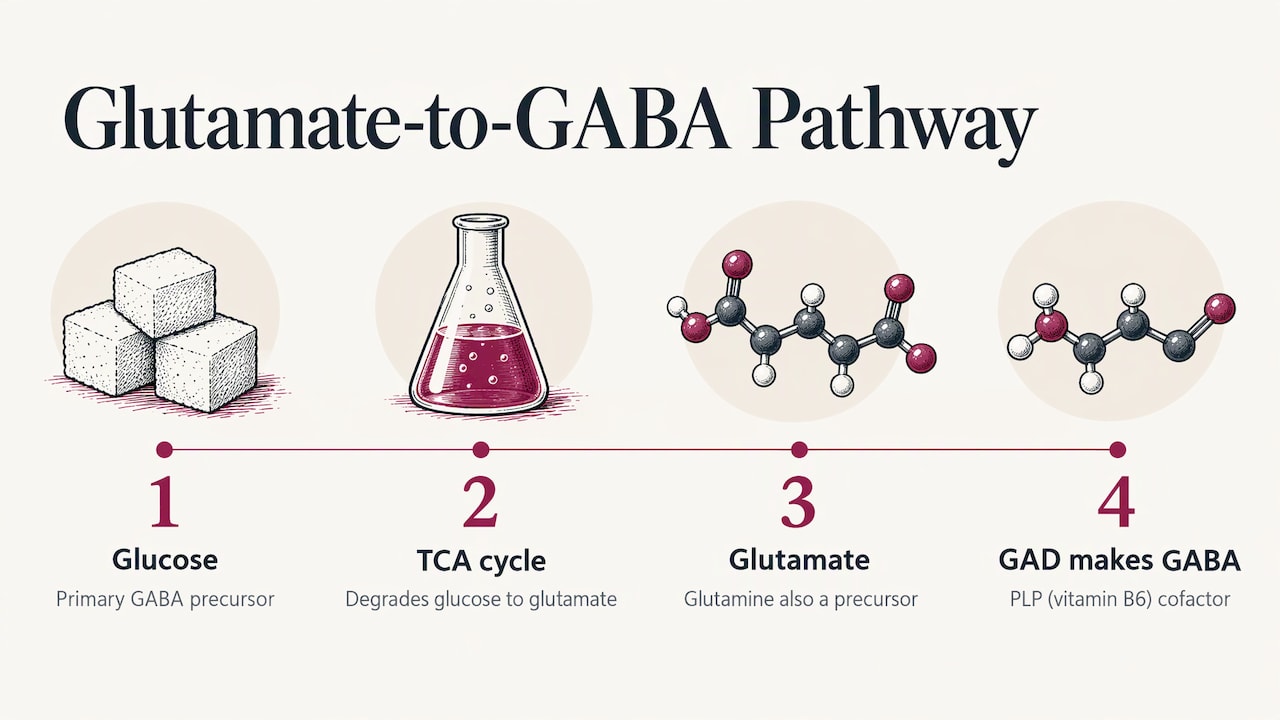
That B6 detail recurs across the whole system. A National Institutes of Health-hosted article on vitamin B-6 states that in the brain, pyridoxal 5’-phosphate is required for the synthesis of serotonin, norepinephrine, epinephrine and GABA, and is therefore involved in both neuronal excitation and inhibition.
Synthesis in plain steps: from plate to synapse
If you want to understand neurotransmitter synthesis without a biochemistry degree, follow one molecule of tyrosine.
- Digestion. Protein in food is broken into amino acids, which enter the bloodstream.
- Transport. The blood-brain barrier has specialized transporting mechanisms that actively move nutrients into the brain, as the OpenStax neurochemistry chapter describes. Precursors compete for these carriers.
- Conversion. Inside the neuron, synthesizing enzymes act on the amino acid. These enzymes use metal ions as co-factors: iron in the substantia nigra, zinc in the hippocampus, copper in the locus coeruleus.
- Packaging and release. The finished transmitter is stored and released when the neuron fires.
- Recycling. Transmitter is cleared and rebuilt, so the supply chain keeps running.
Every link in that chain can be limited by something different: the precursor, the carrier, the enzyme or the cofactor. This is why a single “magic” ingredient is rarely the full story.
Why serotonin and dopamine respond differently to diet
One of the more useful findings in the textbook literature is that the two main monoamine pathways are not equally sensitive. OpenStax notes that tryptophan hydroxylase is only half saturated with tryptophan under normal conditions, while tyrosine hydroxylase is close to saturated. More tryptophan entering the brain therefore leads to more serotonin, making serotonin synthesis more responsive to dietary changes than dopamine synthesis.
Food itself changes the picture. The Wurtman-era research summarized in the PubMed abstract on nutritional state proposes that neurons using choline or monoamines act as sensors of the body’s metabolic state. Its example: carbohydrate consumption accelerates brain serotonin synthesis, and serotonin tends to reduce the desire for more carbohydrates. In other words, the brain’s chemistry and your plate talk to each other.

Cofactors: the part most guides skip
Precursor lists get the attention, but the helpers do the unglamorous work. From the sources above:
- Vitamin B6 is needed for serotonin, norepinephrine, epinephrine and GABA synthesis.
- Iron is required by tyrosine hydroxylase, the first step toward dopamine.
- Copper is required by dopamine-beta-hydroxylase, which makes norepinephrine.
- Tetrahydrobiopterin supports both tyrosine and tryptophan conversion.
- Zinc, vitamin C, folate, B12 and omega-3 fatty acids appear on the Gasmi review’s list of essential nutrients for neurotransmitter synthesis.
A well-built formula treats the pathway as a system, not a single input. That thinking guides how we approach the nervous system as a whole, which we cover in nervous system support.
Getting precursors from food
For most people, food is the baseline. The Gasmi review notes that the GABA precursor also occurs in foods such as spinach, tomatoes and parsley, and that the essential nutrients for synthesis come from the diet. Practical sources include:
- Protein foods (eggs, poultry, fish, dairy, legumes) for tryptophan, tyrosine and phenylalanine.
- Eggs and other choline-rich foods for acetylcholine production.
- Leafy greens, legumes and whole grains for folate and B6.
- Nuts, seeds and shellfish for zinc and copper.
- Fatty fish for omega-3 fatty acids.
Timing and balance matter too. As the nutritional-state abstract describes, carbohydrates raise and protein lowers the tryptophan available to the brain, so a meal’s makeup affects serotonin synthesis. That is a reason to think in terms of whole meals and consistent routines.
Safety: who should be careful with precursor supplements
Precursor supplements are active ingredients, so use them with the same care as any other. Cleveland Clinic states that L-tyrosine supplements are recognized as generally safe by the FDA, but that they may interact with thyroid hormone, MAOIs and levodopa. It also notes that supplements are not FDA-regulated and may contain added additives.
If you take thyroid medication, an MAOI antidepressant or levodopa, talk with your doctor or pharmacist before adding any tyrosine-containing product. Do the same if you are pregnant, nursing, or managing a medical condition. Read the full ingredient label of anything you buy.
For a broader view of safe use, see our guide to nootropics side effects and smart formulation and our page for safe nootropics for beginners.
What this means for focus, mood and stress
The precursor story explains why people link nutrition with how they feel. The Lakhan and Vieira review states that tryptophan, tyrosine, phenylalanine and methionine are often helpful in treating many mood disorders, including depression. Mood conditions need a clinician’s care, so treat that as background on why the amino acids attract research interest, not as self-treatment advice.
For everyday life, the useful takeaways are narrower. Mental clarity, composure and emotional balance rest on a nervous system that has the materials and the cofactors to keep making its messengers. Stress puts steady demand on that system. If you want to go further on that link, read stress and brain fog and how nervous system regulation works.
If you are wondering how soon support can be felt, our guide on how long nootropics take to work separates acute from cumulative effects.
PRESENCE: a restorative approach
Most nootropic products lean on stimulants that push the nervous system harder. We took the other route. PRESENCE is a capsule formula designed to nurture the nervous system with carefully selected ingredients, supporting neurotransmitter health and resilience against nervous system stress. It is designed to improve social intelligence, mental clarity and emotional balance without harsh stimulants.
PRESENCE is available as a one-time purchase or a monthly subscription, from $42 per month. You can see the details on the PRESENCE product page.
If you are new to this category, what nootropics actually do is a good first read before you decide.
Our perspective
Precursor science changed how we think about a formula. The chemistry shows a chain: raw material, transport, enzyme, cofactor. A product that pushes only one point in that chain, usually with a stimulant, asks the nervous system to spend more than it has.
We built PRESENCE around the opposite idea. Our formula is designed to nurture the nervous system, support neurotransmitter health and build resilience against stress, so that clarity and calm develop over time instead of spiking and fading.
That is why we describe the effect in two stages: mental agility within an hour, and a longer-term increase in nervous system capacity. The first is what you notice. The second is what we are building toward.
If you want steady, articulate focus without the jitter, a restorative approach is where we would start.
Calvin
FAQ
What are the main neurotransmitter precursors?
The best-known are tryptophan for serotonin, tyrosine for dopamine, norepinephrine and epinephrine, choline for acetylcholine, and glutamate for GABA. Glucose and glutamine can also feed GABA production. Cofactors such as vitamin B6, iron, zinc and copper help the enzymes finish each conversion.
Which amino acid builds dopamine?
Tyrosine. Enzymes convert it to L-DOPA, then dopamine, then norepinephrine, according to OpenStax. Because the body can make tyrosine from phenylalanine, both amino acids support the pathway.
How are neurotransmitters produced?
Neurons make them internally from precursors delivered by the blood. Transporters carry nutrients across the blood-brain barrier, and enzymes with metal-ion cofactors convert the amino acids, fatty acids or sugars into finished transmitters. Production depends on an adequate supply of precursors.
Do vitamins count as neurotransmitter precursors?
Strictly, vitamins are cofactors rather than precursors. They are not turned into the transmitter, but the enzymes cannot work without them. Vitamin B6 is a clear example: its active form is required to make serotonin, norepinephrine, epinephrine and GABA.
Are precursor supplements safe to take with medication?
Not always. L-tyrosine may interact with thyroid hormone, MAOIs and levodopa, per Cleveland Clinic. If you take any of these, or have a medical condition, check with your doctor or pharmacist before starting a new supplement.
Sources
- When and why should nutritional state control neurotransmitter synthesis? (PubMed)
- 3.1 General Neurochemistry Principles (OpenStax)
- 3.2 Neurotransmitters Made from Amino Acids (OpenStax)
- Neurotransmitters Regulation and Food Intake (PMC)
- Vitamin B-6 (PMC)
- Monoamine molecular messenger, CHEBI:25375 (ChEBI)
- Amino Acid Metabolism (PMC)
- Nutritional therapies for mental disorders (PMC)
- L-Tyrosine Benefits and Side Effects (Cleveland Clinic)