


How to Improve Social Confidence: A Practical Guide
Social confidence is a skill, not a personality trait, and you build it the way you build any skill: with small, repeated, low-stakes practice. You start where it feels manageable, you test your worst-case predictions against what really happens, and you look after the body that has to carry you through the conversation. This guide walks through each of those steps, so you can feel more comfortable around people without forcing yourself to become someone else.
TL;DR
- Social confidence can be developed through practice. Start with one-on-one conversations and low-stakes goals, then move toward bigger groups.
- Most social discomfort comes from predictions, not facts. People tend to rate their own interactions more harshly than the other person does.
- Write down the situation, the thought, and the evidence. It turns vague dread into something you can test.
- Sleep, exercise, and stress management change how your nervous system reacts before you walk into a room.
- If avoidance is starting to disrupt your work, school, or relationships, talk to a mental health professional. CBT is an established treatment.
Table of Contents
- What social confidence actually is
- Why you feel uncomfortable around people
- Step 1: Find the situations and thoughts that trip you up
- Step 2: Build confidence with graded practice
- Step 3: Prepare for conversations without scripting them
- Step 4: Handle nervousness and the inner critic
- Step 5: Track progress and recover from awkward moments
- When to talk to a professional
- Our perspective: calm first, confidence second
- Where PRESENCE fits into your routine
- A four-week starter plan
- FAQ
- Sources
What social confidence actually is
Social confidence is the ability to engage openly and authentically with other people. It does not mean being the loudest person at the party, never feeling nervous, or having a quick comeback for everything. Researchers working on social connection guidelines describe it as something that can be developed through practice, which is the most useful fact in this whole topic. If it can be developed, then feeling awkward today is a starting point and not a verdict.
It helps to separate three things that often get lumped together:
- Shyness or awkwardness: a normal tendency to feel hesitant with unfamiliar people. Many people have it and function well.
- Social confidence: a working sense that you can handle what happens in a conversation, including a slightly awkward moment.
- Social anxiety disorder: persistent, intense fear of social situations because of possible negative judgment, with avoidance or enduring those situations in distress, and problems in daily life. Mayo Clinic describes it in those terms.
Most people reading this are in the first two categories. Later in this guide you will find the signs that suggest you are in the third.
Why you feel uncomfortable around people
The same social connection research points to three habits of mind that make social moments feel harder than they are. People tend to undervalue social opportunities, so they skip them. They perceive greater risks than actually exist. And they evaluate their own interactions less favorably than others do.
In practice, this looks familiar. You decline the invitation because it probably won’t be fun. You replay a sentence from a conversation three days ago that the other person has already forgotten. You assume the pause meant boredom when it meant they were thinking.
The research adds one more piece: difficulty reading what others are thinking and feeling can lead to misguided assumptions, which feed anxiety and create barriers to connection. When you cannot read the room, the brain fills the gap with the worst available explanation.
This matters because it changes the goal. You do not need to eliminate nervousness. You need to collect better information about what actually happens when you talk to people, and to be in a physical state where you can take that information in.
Step 1: Find the situations and thoughts that trip you up
Before you practice, get specific. “I’m bad at socializing” is too big to work on. “I freeze when I have to introduce myself in a meeting” is workable.
Start by reflecting on specific moments of discomfort: what you were doing, who you were with, and where you were. A UK-based mental health charity recommends exactly this kind of reflection for pinpointing triggers. Patterns show up quickly. Maybe it is groups of more than four. Maybe it is people you perceive as senior. Maybe it is the first five minutes of any event.
Then put the thoughts on paper. Two simple formats come from the Centre for Clinical Interventions, a government health service in Western Australia:
- A Thought Challenging Record. You note the social situation, the negative thought or prediction, and the evidence that may not support it. The Overcoming Negative Thinking module walks through it.
- An ABC analysis. You capture the activating event, the consequences (your feelings and your behavior), and the beliefs behind them. The Analysing Your Thinking sheet explains the format.
Here is a short worked example in the ABC style:
| Example | |
|---|---|
| Activating event | A coworker asks what I did over the weekend |
| Belief | “Whatever I say will sound boring. They’re just being polite.” |
| Consequence | Tight chest, one-word answer, I look at my phone |
| Evidence check | They asked a follow-up question last time. I haven’t actually seen them look bored. |
| More realistic thought | “This is a normal opener. A short story with one detail is enough.” |
Five minutes of this after a hard moment is more useful than an hour of general worry.
Step 2: Build confidence with graded practice
Avoidance gives short-term relief and long-term shrinkage. The more you skip, the smaller your comfort zone gets. The reverse also works. Mayo Clinic describes gradual exposure: start with low-stakes social goals and move step by step toward more anxiety-provoking settings, setting small, achievable goals each week.
Cleveland Clinic’s Dr. Potter makes a similar point in 8 Ways To Overcome Social Anxiety: build confidence by starting with one-on-one outings and progressing to larger groups. One person is a far easier room to read than eight.
A sample ladder
Build your own ladder from your own triggers. Here is one version, ordered from easiest to hardest:
- Make eye contact and return a greeting from a neighbor or cashier.
- Ask one genuine question to a barista or a coworker you already know.
- Have coffee or a walk with one friend.
- Say one thing in a small meeting.
- Attend a group event for 30 minutes, with a planned exit.
- Introduce yourself to one new person at that event.
Stay on each rung until it feels merely mildly uncomfortable, then move up. One rung a week is a perfectly good pace. If a step feels impossible, split it in two.
Practice with people who are already safe
Nemours KidsHealth, writing for teens but with advice that applies at any age, suggests practicing eye contact, body language, and small talk with people you already feel comfortable around before branching out to new people. Treat your friends and family as a training ground. Tell one of them what you are working on if you like. It makes the practice less loaded.
Step 3: Prepare for conversations without scripting them
Preparation reduces the number of unknowns, and unknowns are fuel for anxiety. Mayo Clinic lists a few concrete habits: read about current events so you have something to talk about, practice making eye contact, and practice returning greetings.
Nemours adds that rehearsing out loud, or writing down what you want to say, can help you feel more prepared. A few practical ways to use that:
- Keep three go-to questions. “What have you been working on lately?” and “How do you know the host?” carry most events.
- Prepare one or two stories. Something from your week, with one concrete detail, is easier to tell than something improvised.
- Rehearse the first thirty seconds. The opening is usually the hardest part. After that, the other person’s words give you material.
- Plan your exit. Knowing you can leave after an hour makes it easier to arrive.
Don’t memorize full scripts. The aim is a few anchors you can fall back on when your mind goes blank, not a performance.
Step 4: Handle nervousness and the inner critic
You will still feel nervous sometimes, and that is fine. The skill is in how you respond to it.
Challenge the thought, not yourself
Mayo Clinic recommends managing self-critical thoughts by considering the evidence and alternative, realistic outcomes. Ask: what do I actually know? What else could be true? What would I say to a friend who told me this?
That last question comes straight from Nemours: if you are self-critical, ask whether you would be as critical of a best friend, and then try to give yourself the same acceptance. It sounds simple. It works because most people are far kinder in their advice than in their self-talk.
Use your body
The nervous system is part of this story. When you are tired, over-caffeinated, or running on stress, your threshold for feeling threatened drops. Several evidence-based habits help:
- Mindfulness. Harvard Health (2024) states that mindfulness practice can improve quality of life and reduce symptoms in people with social anxiety.
- Aerobic exercise. The same Harvard Health article says aerobic exercise has been shown to be particularly beneficial for social anxiety when combined with cognitive behavioral therapy.
- The basics. Mayo Clinic lists stress-reduction skills, regular physical activity, enough sleep, and a healthy, well-balanced diet among the techniques for handling situations likely to trigger symptoms.
A 20-minute brisk walk before an event, a full night of sleep the day before, and a few slow breaths in the car are not glamorous. They are the foundation everything else sits on.
Step 5: Track progress and recover from awkward moments
Awkward moments are guaranteed. Planning for them is what separates people who keep going from people who quit after one bad conversation.
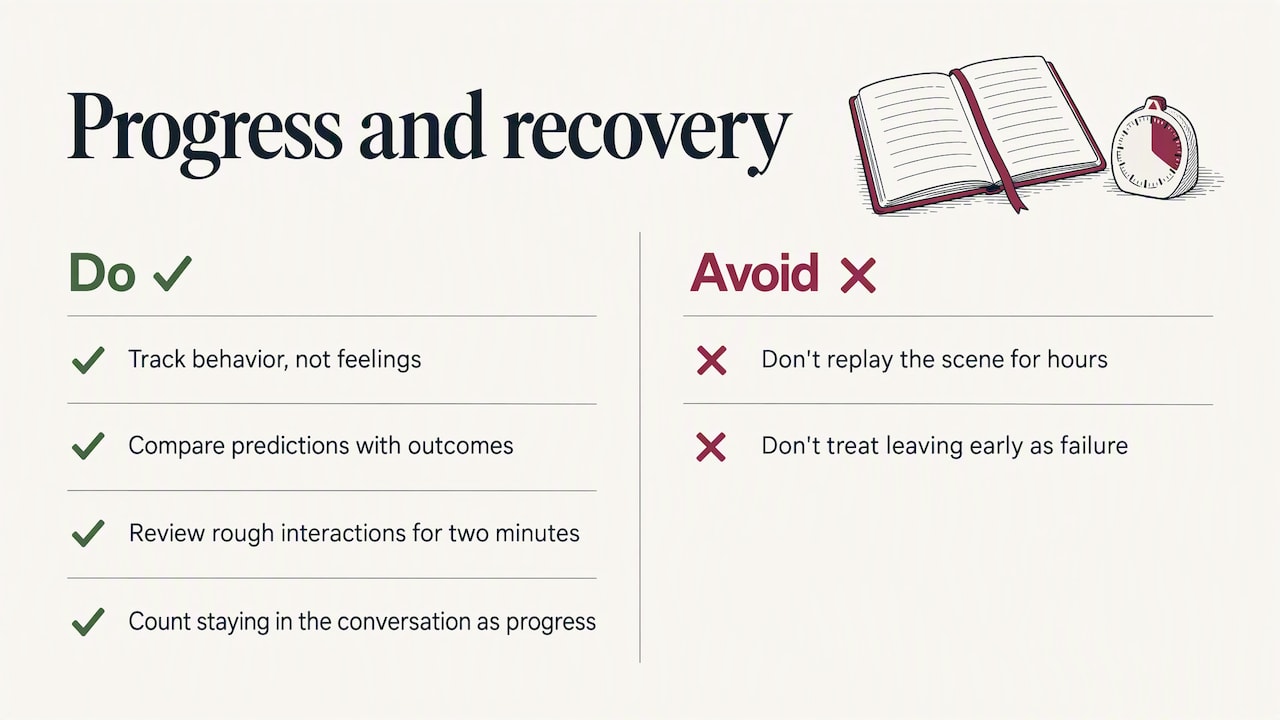
Track behavior, not feelings. You will not always feel more confident right away, but you can count what you did. A simple weekly log works: the situation you attempted, the rung on your ladder, how anxious you felt before and after on a 0 to 10 scale, and one thing that went better than predicted. Over a month, the “before” numbers usually tell a story that your memory won’t.
Compare prediction to outcome. Before an event, write down what you fear will happen. Afterward, write what did. This is the same evidence check from Step 1, applied to real life. The gap between the two is your most persuasive data.
Do a two-minute review after a rough interaction. Use the ABC format: what happened, what you thought, what you did. Identify one thing you would try differently, then stop. A review is useful. Replaying the scene for hours is not.
Redirect attention outward. If you catch yourself analyzing what you just said, shift your focus to the other person’s face and words. You are more likely to connect when you are listening than when you are monitoring yourself.
Count the attempt as the win. Stumbling over a sentence while staying in the conversation is progress. Leaving early because you were afraid is information, not failure. Repeat the same rung next week.
When to talk to a professional
Self-help works for many people, but it has limits. Mayo Clinic says help from a professional may be necessary if fear leads to persistent avoidance that disrupts your work, school, relationships, or daily routine. Examples: turning down a promotion because it involves presenting, skipping classes to avoid group work, or going weeks without seeing anyone you care about.
A licensed therapist, psychologist, or psychiatrist can provide structured therapy. Cognitive behavioral therapy (CBT) is the best known. The National Institute of Mental Health explains that CBT teaches different ways of thinking, behaving, and reacting to situations so you feel less anxious and fearful. Your primary care doctor is a good first call if you do not know where to start.
If you are in crisis or thinking about harming yourself, call or text 988, the Suicide and Crisis Lifeline in the United States.
Our perspective: calm first, confidence second
We build nootropics, so people often ask us whether a capsule can make someone socially confident. Our honest view is that no supplement replaces practice, and we would be wary of any that claims to. Confidence comes from doing the thing, noticing that you survived, and doing it again.
What we do believe is that a stressed, depleted nervous system makes every step harder. When your baseline is wired and exhausted, a simple introduction feels like a threat. That is why we designed PRESENCE around a restorative approach rather than harsh stimulants: it is meant to support neurotransmitter health and resilience against nervous system stress, so that mental clarity and emotional balance have a better chance to show up when you need them. Stimulant-heavy products tend to push in the opposite direction, which is the last thing you want before a conversation that already makes you nervous.
We also think the benefits should build over time. Think of it as supporting the foundation while you do the real work of practice. If you want to understand the reasoning, our articles on nervous system support and on which nootropics work best for anxiety go into the mechanisms.
— Calvin
Where PRESENCE fits into your routine
PRESENCE is our restorative nootropic capsule, formulated to support social intelligence, mental clarity, and emotional balance without harsh stimulants. It is available as a one-time purchase or a monthly subscription, from $42 per month. It is not a treatment for social anxiety or any medical condition, and it works best alongside the habits above: graded practice, sleep, movement, and an honest look at your thoughts.
If you are new to this category, start with our guide to safe nootropics for beginners, and check with your doctor before adding any supplement, especially if you take medication or have a medical condition. When you are ready, you can see the full details on the PRESENCE product page.
A four-week starter plan
If you want a concrete place to begin, try this.
Week 1: Observe. Keep a log of every moment you felt uncomfortable around people. Note the where, who, and what. Do two ABC entries. Do not try to change anything yet.
Week 2: Low-stakes contact. Pick two rungs from the bottom of your ladder. Greet people, ask one real question, and keep eye contact for a moment longer than usual. Rate your anxiety before and after.
Week 3: One-on-one. Schedule coffee or a walk with one person. Prepare three questions and one story. Afterward, write down what you predicted and what happened.
Week 4: Small group. Attend something with a few people, set a time limit, and plan your exit. Introduce yourself to one person. Then review the month: which rungs got easier?
Then build a new ladder from where you are now. Sleep, movement, and stress care stay in the plan the whole time.

FAQ
How long does it take to improve social confidence?
There is no fixed timeline, because it depends on how often you practice and how big the gap feels. Most people notice that specific situations get easier within weeks of regular, small exposures, while broader confidence builds over months. Consistency matters more than intensity, so one small step each week beats one huge push.
How can I feel more comfortable around people I don’t know well?
Start with one-on-one settings, where it is easiest to read the other person, and prepare a few questions in advance. Practice eye contact and small talk with people you already trust before branching out. Focus on listening rather than monitoring yourself, and remember that people tend to judge their own interactions more harshly than others do.
Is it normal to feel anxious in social situations?
Yes, mild nervousness around others is very common. It becomes a concern when fear is intense and persistent, leads you to avoid situations, or interferes with work, school, or relationships. In that case, a mental health professional can help, and CBT is an established approach.
Can a supplement make me more socially confident?
No supplement can replace practice, and no product should promise to fix social anxiety. A restorative formula like PRESENCE is designed to support mental clarity and emotional balance by looking after the nervous system, which can make practice feel less draining. Talk to your doctor before starting any supplement.
Sources
- Cultivate social confidence in yourself and others, Social Connection Guidelines
- Social anxiety disorder (social phobia): Diagnosis and treatment, Mayo Clinic
- Module 2: Overcoming Negative Thinking, Centre for Clinical Interventions
- Analysing Your Thinking, Centre for Clinical Interventions
- Identifying situations and understanding your social anxiety, Walk the Talk
- 8 Ways To Overcome Social Anxiety, Cleveland Clinic
- 5 Ways to Shake Shyness, Nemours KidsHealth
- Social anxiety disorder: Treatments and tips, Harvard Health
- Social Anxiety Disorder: What You Need to Know, NIMH



One Comment