


Afternoon Brain Fog: Why It Hits and How to Clear It
If your thinking turns slow and cloudy somewhere between 2 and 5 p.m., you are not imagining it. A natural dip in alertness, a heavy lunch, too little sleep and stress can all stack up in the same few hours. Most of those causes are fixable with small changes to how you sleep, eat and move. A few are not, and those are worth a conversation with a doctor.
This guide explains what afternoon brain fog is, why the afternoon is when it shows up, what to change first, where a restorative nootropic fits, and which signs mean you should stop troubleshooting on your own.
TL;DR
- Alertness commonly bottoms out in the early-to-mid afternoon, and circadian timing is the most likely reason, even when you slept fine.
- Short sleep, a large or sugary lunch, stress and too little movement can turn a normal dip into real fog.
- The highest-return fixes are boring: a smaller balanced lunch, a 10 to 30 minute walk, daylight and a consistent sleep schedule.
- Fog that lasts more than two weeks despite enough sleep, or that gets in the way of daily life, deserves a medical evaluation.
- A supplement is a support layer, not a repair for poor sleep or an underlying condition.
Table of Contents
- What afternoon brain fog actually feels like
- Why it happens in the afternoon
- A quick way to work out your likely cause
- What to change first
- Perspective: where a restorative nootropic fits
- If you want support on top of the basics
- When afternoon brain fog is not just an afternoon problem
- FAQ
- Sources
What afternoon brain fog actually feels like
Brain fog is not a diagnosis. It is a cluster of symptoms that affect clear thinking: trouble focusing, slower processing, forgetfulness and losing your train of thought. Cleveland Clinic describes it as a group of symptoms touching focus, concentration, memory and attention, and says it can feel like confusion, mental exhaustion, word-finding difficulty or trouble finishing routine tasks.
The afternoon version has a recognizable signature:
- You reread the same paragraph of an email three times.
- A task that took ten minutes in the morning now takes thirty.
- You reach for a word and it is not there.
- You feel sleepy as well as foggy: heavy eyelids, yawning, a pull toward the couch. Johns Hopkins Medicine lists midafternoon sleepiness, yawning and difficulty keeping your eyes open as a common late-day energy lag.
- The fog lifts, at least partly, by evening.
That last point is useful. A pattern tied to the clock points toward timing, meals and sleep debt. Fog that is present all day, every day, points elsewhere.
Why it happens in the afternoon
Your body clock dips after lunch
Alertness is not a flat line. The Washington Post reports that it commonly reaches a low point from about 2 to 5 p.m., and that circadian timing is the most likely explanation for an otherwise ordinary dip. Skipping lunch entirely will not make it vanish. Lunch can make the dip feel deeper, though.
The meal effect
Eating can cause short-term sleepiness and sluggishness. Cleveland Clinic says it usually peaks one to two hours after a meal and is stronger after larger, higher-energy meals. It can begin anywhere from 30 minutes to four hours after eating, and it can reduce alertness and performance on tasks that need focus. The proposed mechanisms include gut signals, blood glucose and amino acids, brain arousal pathways and that early-afternoon body-clock dip.
Be wary of tidy stories here. The Washington Post notes that meal studies are limited and do not prove causation, and RTÉ Brainstorm reports that larger lunches are linked to poorer attention and more post-meal sleepiness, while no single carbohydrate, fat or protein category is proven to explain every slump. The practical takeaway is meal size and composition, not a villain nutrient.
Sleep debt shows up at 3 p.m.
A short night often feels fine at 9 a.m. and costly at 3 p.m. American Family Physician reports that nearly 30% of U.S. adults sleep fewer than seven hours a night. The same primary-care guidance points to sleep amount and quality as the first thing to review in a patient with fatigue, and to screening higher-risk patients for sleep apnea.
Stress, movement and everything else
Cleveland Clinic’s guidance on the afternoon slump names natural cortisol variation, insufficient sleep, high-sugar or refined-carbohydrate meals, stress and too little exercise as possible contributors. Northwestern Medicine adds poor nutrition, illness or infection, hormonal changes and certain medications, including sleep aids and older antihistamines.
If the day is also a string of meetings, notifications and decisions, the fog is not only biological. Mental overload is cumulative, and by mid-afternoon the bill arrives. If that sounds like your week, our practical plan for recovering from mental exhaustion goes deeper.
A quick way to work out your likely cause
Use this as a starting map, not a diagnosis.
| What you notice | Likely contributor | First thing to try |
|---|---|---|
| Fog and sleepiness 1 to 3 hours after a big lunch | Meal size or composition | Smaller lunch with protein and fiber |
| Fog on days after a short night | Sleep debt | Consistent bedtime for a week |
| Fog worst on back-to-back meeting days | Stress and mental load | Scheduled breaks, a walk, a screen-free reset |
| Fog plus loud snoring or waking unrefreshed | Possible sleep apnea | Talk to a doctor |
| Fog every day, even after good sleep, lasting weeks | Something medical | Medical evaluation |
What to change first
The evidence-backed fixes are not glamorous, and they work best in combination.
Rethink lunch
Cleveland Clinic suggests smaller, balanced meals that prioritize protein, fiber and lower-glycemic carbohydrates, and limiting alcohol at lunch. The Washington Post similarly recommends a lunch built around vegetables, fiber and complex carbohydrates while limiting sugary drinks and refined carbohydrates.
A workable version: a salad or grain bowl with chicken, beans or eggs, a piece of fruit, water. Skip the large soda and the pastry on the side. If you want to test it, change only lunch for five workdays and note how 3 p.m. feels.

Walk after you eat
A 10 to 30 minute walk after eating is one of the steps Cleveland Clinic lists for post-meal sluggishness. Its afternoon-slump guidance also supports regular physical activity such as walking. Bright light helps too: the Washington Post notes that a brisk walk and bright light may help, so take the walk outside when you can.
Nap only if you can do it right
Cleveland Clinic suggests a five- to 10-minute early-afternoon nap for the slump, and a 20-minute nap when possible after a meal. Keep it short and early. A long nap at 4 p.m. can cost you sleep that night, which feeds tomorrow’s fog.
Use caffeine with a cutoff
The Washington Post notes an early-afternoon caffeine dose may help, but it can disrupt nighttime sleep. That tradeoff is the whole story with coffee: it borrows against tonight. If you are leaning on it harder every month, read whether nootropics can replace coffee.
Protect sleep
The primary-care guidance in American Family Physician recommends keeping consistent sleep schedules, limiting screen time, and avoiding caffeine and alcohol near bedtime. Northwestern Medicine’s brain fog advice adds regular exercise, nutritious food, mindfulness or deep breathing, organizational aids and breaks.
A simple afternoon protocol
- Eat a smaller, balanced lunch with protein and fiber.
- Walk for 10 to 30 minutes, outdoors if possible.
- Schedule your hardest cognitive work for the morning and your email, admin and routine tasks for the dip.
- If you need caffeine, have it early in the afternoon, not late.
- Take a short break every 60 to 90 minutes: stand up, look out a window, breathe slowly.
- Keep your bedtime and wake time within an hour of each other, including weekends.
Perspective: where a restorative nootropic fits
We built PRESENCE around a view that many focus products get wrong. Most reach for stimulation: push the nervous system harder and accept the rebound. Afternoon fog is often the rebound. If your system is already tired, stress-loaded or running on short sleep, more stimulation tends to borrow from tomorrow.
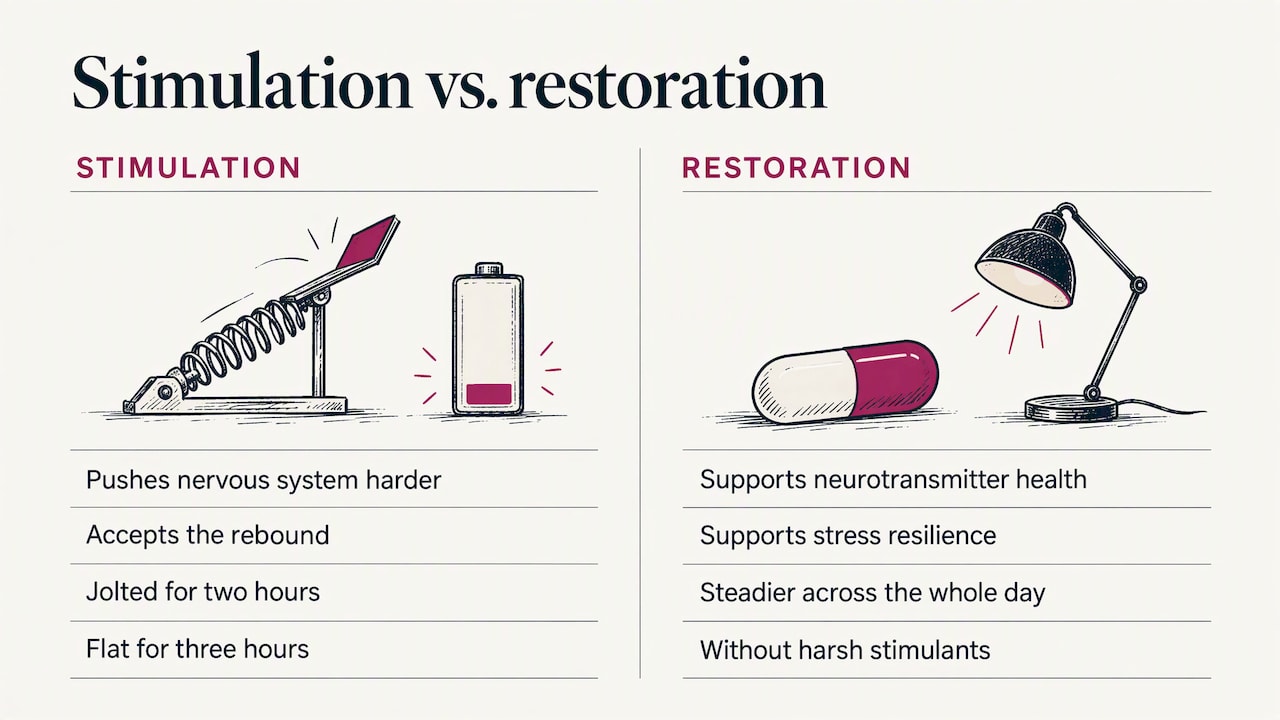
Our approach is restorative. PRESENCE is a capsule formulated to support neurotransmitter health and the nervous system’s resilience to stress, aiming for mental clarity and emotional balance without harsh stimulants. We would rather you feel steadier across the whole day than jolted for two hours and flat for three.
We also want to be straight about limits. A supplement does not replace sleep, a decent lunch or a walk, and it does not treat a thyroid problem, anemia or sleep apnea. We see it as one layer on top of the basics, and the basics come first. Our owner-side experience is that people who fix lunch and sleep and then add nervous system support get a clearer picture of what actually moves their afternoons. For the thinking behind this, see our piece on nervous system support as a foundation for performance.
— Calvin
If you want support on top of the basics
PRESENCE is our restorative nootropic: capsules built to support clarity, calm and stress resilience without leaning on harsh stimulants. It is available as a one-time purchase or a monthly subscription, from $42 per month. You can read the full details on the PRESENCE product page.
If you are new to this category, start with safe nootropics for beginners, and check what to expect on timing, since some effects are acute and others build over weeks. If you take prescription medication, are pregnant or nursing, or have a medical condition, ask your clinician before adding any supplement. That includes ours.
When afternoon brain fog is not just an afternoon problem
Ordinary dips are common. These are not:
- Fog that lasts. Cleveland Clinic advises medical evaluation when fatigue lasts more than two weeks despite adequate sleep.
- Fog that interferes with life. Cleveland Clinic says to seek advice when it gets in the way of daily life, such as frequently missed appointments, trouble completing ordinary tasks or difficulty following conversation.
- Specific warning signs. Northwestern Medicine advises medical attention for symptoms that don’t improve, especially ongoing trouble remembering conversations or events, word-finding or language difficulty, information-processing problems, mood or personality changes, or trouble with everyday tasks.
- Sleepiness with snoring or unrefreshing sleep. The Washington Post notes that conditions including obstructive sleep apnea, anemia and thyroid disorders can intensify afternoon sleepiness.
Start with your primary care doctor. Bring a one-week log of when the fog hits, what you ate, how you slept and what medications you take. That log is more useful to a clinician than any description from memory.
FAQ
Is afternoon brain fog normal?
A mild dip between about 2 and 5 p.m. is common and largely driven by circadian timing. It becomes a concern when it is severe, daily despite enough sleep, or interferes with work and home life. At that point, get it checked.
Does lunch cause brain fog?
It can contribute. Post-meal sleepiness usually peaks one to two hours after eating and is stronger after larger, higher-energy meals. The research does not point to one guilty food group, so focus on smaller, balanced meals with protein and fiber.
Will coffee fix it?
An early-afternoon dose may help for a while, but caffeine can disrupt nighttime sleep, which makes the next afternoon worse. If you rely on more each week, treat that as a sign to look at sleep, meals and stress.
Can a supplement help with afternoon brain fog?
Some people use a restorative nootropic such as PRESENCE as a support layer alongside better sleep, lunch and movement. It is not a substitute for those, and it is not a treatment for a medical condition. Talk to your clinician first if you take medication or have a health condition.
Sources
- Brain Fog: What It Is, Causes, Symptoms & Treatment (Cleveland Clinic)
- Overcoming Your Midafternoon Energy Slump (Johns Hopkins Medicine)
- Why do I get sleepy in the afternoon after eating lunch? (The Washington Post)
- What Is a Food Coma (Postprandial Somnolence)? (Cleveland Clinic)
- Why do I crash at 3pm? (RTÉ Brainstorm)
- Fatigue in Adults: Evaluation and Management (American Family Physician)
- Afternoon Slump? 5 Ways to Restore Your Energy (Cleveland Clinic)
- Feeling Foggy? What To Know if You Experience Brain Fog (Northwestern Medicine)



2 Comments