
How to Quiet Racing Thoughts: What Helps Now and Later
To quiet racing thoughts, start with your body, not your argument with the thoughts. Slow your breathing, name what is happening, ground yourself in what you can see and hear, and move for a few minutes. Then build habits that lower the baseline: a protected wind-down, a scheduled worry window, and support for a nervous system that is running hot. This guide covers all three, plus the signs that mean it is time to talk to a professional.
TL;DR
- Racing thoughts are fast, repetitive or bouncing thoughts, and anxiety is the most common cause.
- In the moment: label them as noise, count your breaths, ground yourself with your senses, and move for five minutes.
- At night: use a screen-free buffer, progressive muscle relaxation and an early-evening worry journal so worries stay out of bed.
- Over time, sleep, movement and nervous system support do more than any single trick.
- If symptoms last two weeks or more, or you have thoughts of self-harm, get professional help. In the US, call or text 988.
Table of Contents
- What racing thoughts actually are
- How to quiet racing thoughts in the moment
- How to calm racing thoughts at night
- Calming racing thoughts naturally, over time
- Where nervous system support fits
- Try PRESENCE
- When racing thoughts need a professional
- FAQ
- Sources
What racing thoughts actually are
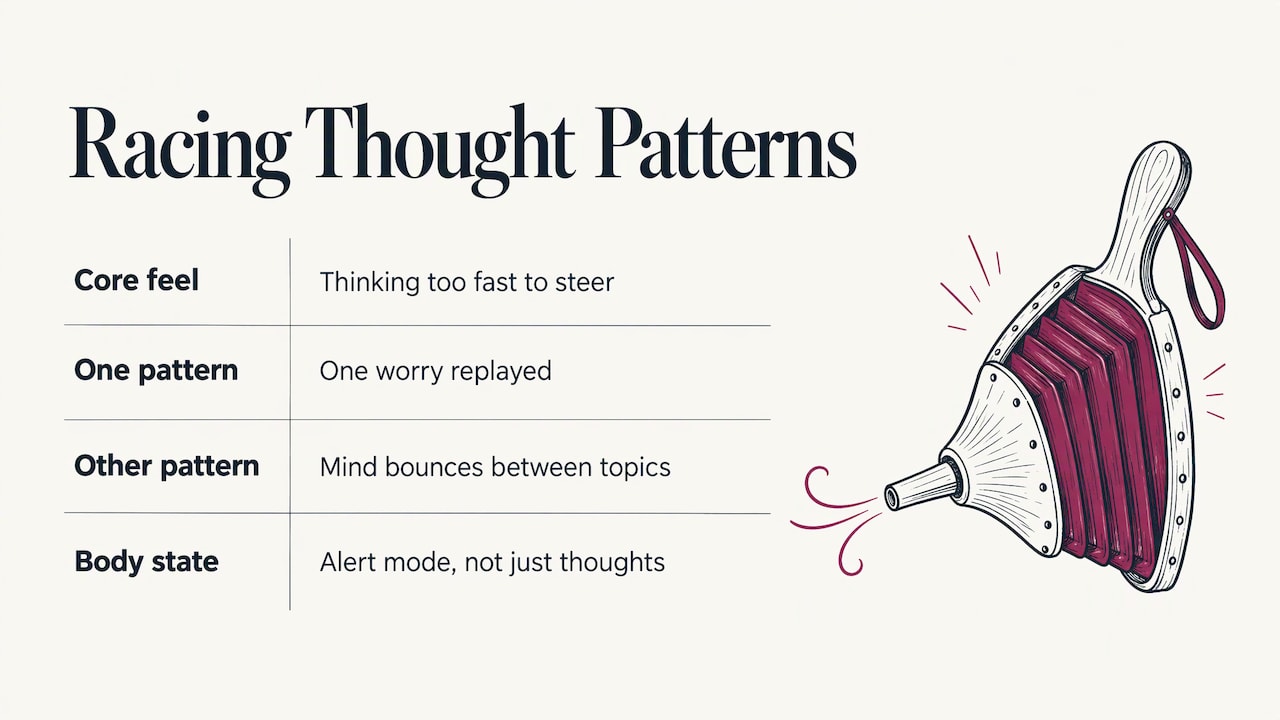
Racing thoughts are a stream of thinking that feels too fast to steer. Sometimes you fixate on one worry and replay it. Sometimes your mind bounces from topic to topic. Harvard Health describes both patterns and names anxiety as the most common cause, and says they can also relate to ADHD, OCD, trauma or other mental health issues.
They are not always a sign of a disorder. Verywell Health notes that healthy people can experience racing thoughts too, often along with trouble managing emotions, trouble sleeping and a keyed-up, hyperaroused feeling.
That last part matters. Racing thoughts are rarely just a thinking problem. They are a thinking problem riding on a body that is in alert mode. This is why the techniques that work best tend to involve breathing, movement and the senses rather than more thinking.
Why your mind might be racing
Medical News Today lists a wide range of contributors: anxiety, depression, panic disorder, chronic stress, recreational drug use, some prescription drugs, and certain medical conditions. Healthline adds that ADHD, OCD, bipolar disorder and agitated depression are associated with racing thoughts, and that medications for depression, anxiety or bipolar disorder can sometimes cause agitated depression that triggers them.
A practical way to sort through your own pattern is to look at the content. A clinical team at Savant Care points out that anxiety-driven racing thoughts tend to circle back to specific fears and elaborate worst-case scenarios, while mood-related racing thoughts tend to be faster, more disjointed and paired with changes in mood or energy. That is a useful clue to bring to a professional, not a way to diagnose yourself.
Common everyday triggers worth checking first:
- A stretch of poor sleep
- A looming deadline or unresolved conflict
- Too much caffeine late in the day
- Little movement and long stretches of screen time
- Nothing scheduled to process worries, so they show up at bedtime
How to quiet racing thoughts in the moment
The goal in the moment is not to win an argument with your mind. It is to lower the intensity enough that you can choose what to do next. Try these in order, or pick the one that suits where you are.
1. Call it noise
Harvard Health recommends giving yourself permission to have the thoughts and acknowledging them as “just noise.” Per psychologist Dr. Fabrett, this gives a sense of control and makes the thoughts feel less threatening and easier to manage. Fighting the thoughts usually adds a second layer of stress on top of the first.
2. Count your breaths
Harvard’s version is simple: close your eyes, count one on the inhale and two on the exhale, continue up to 10, then start over until you settle. Dr. Fabrett notes it is also a good remedy before sleep.
If you prefer a structured pattern, the Sleep Foundation describes 4-7-8 breathing: inhale through the nose for 4 counts, hold for 7, exhale through the mouth for 8. It notes that breathing exercises may help sleep by reducing nervous system arousal. Mental Health America guidance cited by Medical News Today suggests another option: breathe in for a count of five, hold briefly, and breathe out for five.
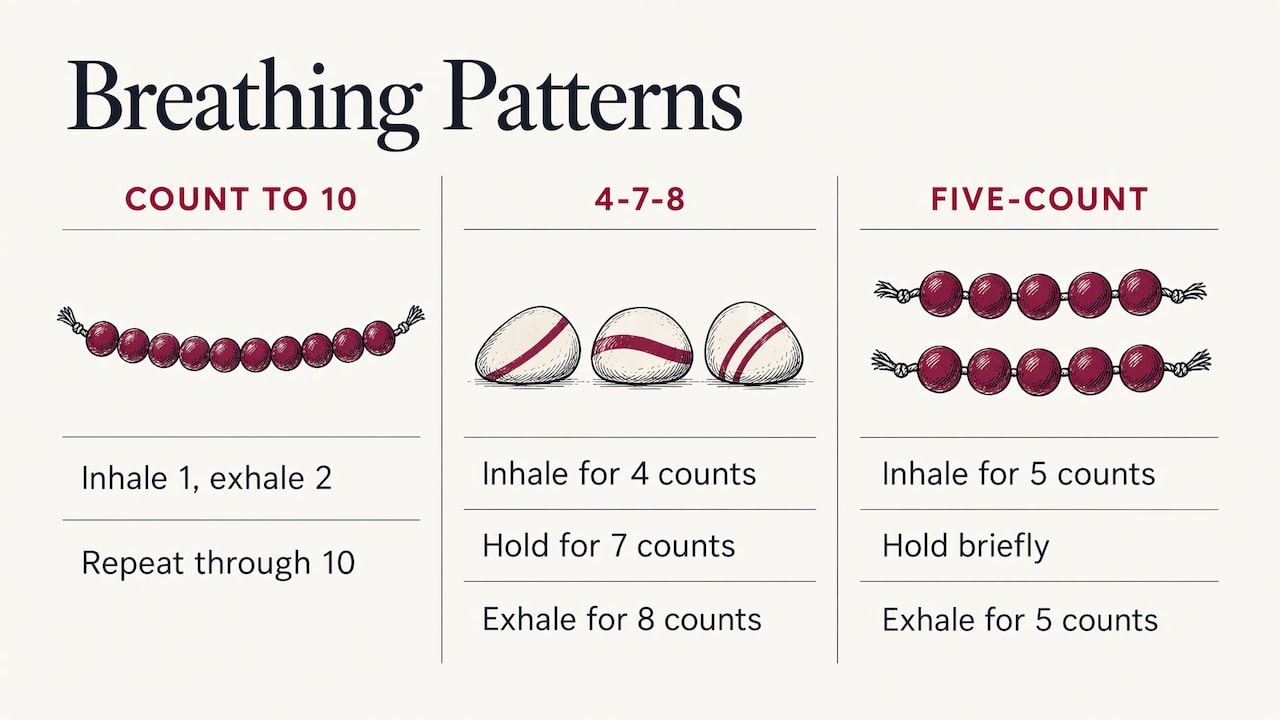
The common thread is a longer, slower exhale and something simple to count so your attention has a job.
3. Ground yourself in your senses
Grounding pulls attention out of your head and into the room. Cleveland Clinic describes the 3-3-3 method from Dr. Young: notice three things you can see, three you can hear and three you can touch. It can help you feel more present when anxiety is consuming your mind.
A longer version is 5-4-3-2-1: five things you can see, four you can feel, three you can hear, two you can smell and one you can taste. MindWell describes it as a way to calm racing thoughts and reconnect with your surroundings.
4. Move for five minutes
Harvard Health suggests short bursts of activity such as push-ups, jumping jacks or a five-minute walk, plus distracting yourself by making an internal comment and then doing something else.
If you work at a desk, the hard part is remembering to get up before your head is already spinning. Planned reminders help. A guide to smart stand-up reminders explains why generic alerts get ignored and how better-timed ones fit around your day.
A quick sequence to keep in your pocket
- Say to yourself: “This is noise, and it will pass.”
- Do ten counted breaths.
- Run through 3-3-3 with your eyes open.
- Walk for five minutes, ideally outside or at least away from your screen.
- Write down the one thing you still need to act on, and put the rest aside.
It takes under ten minutes, and each step gives a different part of the stress response something to do.
How to calm racing thoughts at night
Night is when racing thoughts hit hardest for many people. The Sleep Foundation explains that anxiety often feels worse at night because there are fewer distractions, so worries find room to interfere with falling asleep. Nighttime anxiety can bring a racing mind, muscle tension, a rapid heartbeat, sweating and trouble falling or staying asleep.
This is not just a feeling. A 2023 review in the Journal of Sleep Research confirms that cognitive arousal, meaning excessive worry and rumination, is a central feature of many insomnia models and often intensifies in the pre-sleep period.
Build a wind-down that protects sleep
Cleveland Clinic’s sleep guidance recommends a 30 to 60 minute screen-free buffer before bed. Healthline goes further and suggests reducing stress for at least two hours before sleep, avoiding screens and overly stimulating mental activity, and using calming routines such as gentle yoga, reading or a bath.
A realistic evening might look like this:
- Early evening: a 15-minute worry journal (below)
- An hour before bed: screens away, lights lower
- Thirty minutes before bed: five minutes of guided meditation, or 4-7-8 breathing
- In bed: progressive muscle relaxation from toes to shoulders
Use a worry journal and a to-do list
Cleveland Clinic’s Dr. Drerup suggests dedicating 15 minutes early in the evening to writing down worrisome thoughts. It is a tangible way to contain worry so you are not bringing concerns to bed. Harvard Health similarly recommends scheduled worry time: explore the thoughts and write them down without editing.
The Sleep Foundation adds that research suggests writing a detailed to-do list before bed helps people fall asleep faster. If a new worry pops up in bed, you can tell yourself it is already on the list or goes on tomorrow’s.
Relax the body, not just the mind
Progressive muscle relaxation means tensing and releasing muscle groups from your toes up to your shoulders. Cleveland Clinic says it helps release the muscle tension that racing, anxious thoughts create. Give it a few nights before judging it. Dr. Drerup notes that meditation practices can take numerous sessions to learn, so start small, with five minutes before bed.
If nighttime anxiety keeps disrupting sleep, the Sleep Foundation notes that CBT-I is usually the first treatment recommended for insomnia linked to it. A doctor or sleep specialist can point you to a qualified provider.
Calming racing thoughts naturally, over time
In-the-moment tools stop a spiral. Fewer spirals come from a calmer baseline. Mindfulness is a good example: Dr. Drerup explains that mindfulness-based techniques train you to view your thoughts from a curious standpoint instead of buying into them, which can reduce fight-or-flight arousal. It builds with repetition.
A few habits to stack:
- Daily movement. Short bursts count. Consistency matters more than intensity.
- A fixed wake time. Sleep regularity makes the nighttime version of this problem less likely.
- Limit late caffeine. A racing mind and a stimulant are an unhelpful pair.
- A daily worry slot. Fifteen minutes, same time, pen and paper.
- A stress recovery plan. Our guide to recovering from stress lays out the practical steps.
We also cover how the body side of this works in our pieces on calming your nerves naturally, remaining calm under pressure and nervous system regulation. If your issue is drifting attention rather than speed, see how to stop mind wandering.
Our perspective
We build PRESENCE around a simple idea: a racing mind is often a tired, over-activated nervous system, and pushing it harder with stimulants rarely helps. Most people reaching for focus or calm are already running hot.
That is why our approach is restorative. PRESENCE is designed to support neurotransmitter health and resilience against nervous system stress, with ingredients chosen to avoid the harsh edge that stimulant-heavy nootropics can have. Our aim is clarity and emotional balance that develops over time.
We see it as a companion to the habits above, not a replacement for them. Breathing, grounding, movement and a protected evening routine give a settled nervous system the best conditions to work with. A formula built for nervous system capacity is one more layer under those habits.
The people who do best with this kind of support treat it like training: consistent, patient, and paired with sleep and daily rhythm.
Calvin
Where nervous system support fits
If your racing thoughts come with a body that feels wired, you may be interested in support aimed at the nervous system rather than a stimulant. Our overview of which nootropics work best for anxiety without sedation explains the thinking, and nervous system support covers the foundation. If you are new to the category, start with safe nootropics for beginners.
Try PRESENCE
PRESENCE is our restorative nootropic in capsule form. It is designed to support neurotransmitter health, resilience to nervous system stress, mental clarity and emotional balance, without harsh stimulants. We describe mental agility improving within an hour for many people, with nervous system capacity building over time. It is available as a one-time purchase or a monthly subscription, from $42 per month.

You can see the formula and purchase options on the PRESENCE product page. If you take prescription medication or have a medical condition, check with your doctor or pharmacist before adding any supplement.
When racing thoughts need a professional
Self-help tools suit occasional or stress-related racing thoughts. Some patterns call for a clinician.
Talk to your doctor or a mental health professional if:
- Symptoms last two weeks or more and affect sleep, concentration or daily tasks. NIMH advises seeking help for severe or distressing symptoms lasting 2 weeks or more, including irritability, restlessness and inability to complete usual tasks.
- You feel panic, have fears you cannot control, or cannot function at work. MedlinePlus advises contacting your health care provider in these situations.
- Self-care has not helped, or the symptoms are frequent, long lasting or severe, as Healthgrades outlines.
- Racing thoughts come with a decreased need for sleep, elevated or irritable mood lasting days, more energy than usual, or impulsivity. These are signals that may point to a mood disorder and warrant a clinical evaluation.
- You started a new medication around the time the thoughts began. Ask the prescriber, and do not stop it on your own.
Get urgent help if your thoughts include self-harm or suicide, or you hear voices or lose track of what is real. In the US, call or text 988, the Suicide & Crisis Lifeline, which is free, confidential and open 24 hours a day. In a life-threatening situation, call 911.
FAQ
How do I quiet racing thoughts right now?
Label them as noise, then count your breaths: one on the inhale, two on the exhale, up to 10. Follow with a grounding exercise such as naming three things you see, hear and touch. A five-minute walk or a few jumping jacks can finish the job.
Why do racing thoughts get worse at night?
There are fewer distractions at night, so worries have more room. Sleep research also shows that worry and rumination tend to peak in the pre-sleep period, especially in people with insomnia. A worry journal earlier in the evening and a screen-free buffer before bed can help.
Can I calm racing thoughts naturally?
For many people, yes. Slow breathing, grounding, movement, mindfulness, progressive muscle relaxation and scheduled worry time are all recommended by medical sources. They work best when practiced regularly, not only during a spiral. Persistent symptoms deserve a conversation with a professional.
Are racing thoughts a sign of a mental health condition?
Not necessarily. Healthy people can have them during stress or poor sleep. But they are linked to anxiety, ADHD, OCD, depression and bipolar disorder, so if they last two weeks or more or disrupt your life, see a doctor or mental health professional.
Can a supplement help with racing thoughts?
A supplement is not a treatment for a medical condition. Our PRESENCE formula is designed to support the nervous system and emotional balance without harsh stimulants, alongside sleep, movement and calming habits. Talk to your doctor first if you take medication or have a health condition.
Sources
- Slowing down racing thoughts, Harvard Health
- Overcoming Racing Thoughts in Anxiety, ADHD, and More, Verywell Health
- Racing thoughts: 7 ways to stop or slow them, Medical News Today
- Racing Thoughts: Tips for Coping, Healthline
- Racing Thoughts: What Causes Them and How to Stop Them, Savant Care
- 13 Grounding Techniques To Help Calm Anxiety, Cleveland Clinic
- Find ways to calm or distract yourself, MindWell
- How To Stop Your Mind from Racing and Get To Sleep, Cleveland Clinic
- Anxiety at Night: Causes and Tips for Relief, Sleep Foundation
- Hyperarousal in insomnia disorder, Journal of Sleep Research
- Caring for Your Mental Health, NIMH
- Stress and your health, MedlinePlus
- When to Contact a Doctor for Anxiety and Panic Attacks, Healthgrades
- Smart stand-up reminders for desk jobs