

Adaptogens Explained: What They Are and How They Work
Adaptogens are herbs, roots and mushrooms that are said to help your body handle stress and return to a steady state afterward. The idea is old and the research is real but uneven, so the useful question is which adaptogen, at what dose, for what purpose. If you want clearer thinking and steadier moods without the jolt of a stimulant, the principle behind adaptogens is worth understanding: support the nervous system’s ability to recover, don’t push it harder. That restorative principle is the one behind our PRESENCE supplement.
TL;DR
- An adaptogen is a plant substance, often an herb, root or mushroom, that is meant to be nontoxic and to help the whole body cope with stress and return to balance.
- They are not stimulants. The original concept separates them from stimulants, which give a short boost followed by a drop.
- The evidence differs by plant. Ashwagandha, Rhodiola and Bacopa have the most research, and results depend on the dose, the extract and the length of use.
- In the US, supplements are not tested or approved by the FDA before sale, and some adaptogens interact with medicines. Check with your doctor first.
- For focus and calm, the goal is a nervous system that recovers well, which is what we build PRESENCE around.
Table of Contents
- What does “adaptogen” mean?
- How adaptogens are thought to work
- The adaptogens you will see most often
- Do adaptogens help with focus and clarity?
- Do adaptogens give you a buzz or a high?
- Use them safely
- What the FDA does and does not check
- How to choose and use an adaptogen well
- Why we take a restorative approach
- Try PRESENCE
- FAQ
- Sources
What does “adaptogen” mean?
The word describes a job, not a chemical family. UCLA’s public health school describes adaptogens as herbs, roots and other plant substances, mushrooms included, that help the body manage stress and restore balance after a stressful situation. To count, a substance should be nontoxic at normal doses, support the whole body’s ability to cope with stress, and help it return to a stable state.
The term goes back to the Soviet scientist N.V. Lazarev in 1947. The European Medicines Agency’s herbal committee traces the concept to him and to later work by Brekhman. They described an adaptogen as nearly non-toxic and non-specific: it raises resistance to a broad range of stressors and has a normalizing effect on the body’s systems. The same paper separates adaptogens from stimulants, whose single-dose boost to work capacity is followed by a decrease.
The Merck Manual adds some history. The word came from researchers looking for ways to improve endurance and reduce fatigue during extreme physical activity and in harsh environments. Later, advocates extended the claimed uses to energy, mood, memory and more.
In short, “adaptogen” is a category defined by how a substance is meant to behave: broad, gentle, balancing and non-stimulating.
How adaptogens are thought to work
Stress is not only a feeling. It is a chain of physical events, and the main control center is the hypothalamic-pituitary-adrenal (HPA) axis. That is the pathway linking your brain to your adrenal glands, and it releases stress hormones such as cortisol. UCLA Health experts say adaptogens are believed to interact with the HPA axis, which starts the stress response and helps keep the body in balance.
Cleveland Clinic describes the effect as working in both directions. If stress has pushed cortisol too high, an adaptogen would bring it down. If long-running fatigue has left cortisol low, it would help bring it back toward balance. That two-way, “normalizing” behavior is what separates the concept from a stimulant or a sedative.
A 2026 review of the mechanisms summarizes several routes studied in the lab:
- Regulation of the HPA axis.
- Induction of heat-shock proteins, which help cells cope with strain.
- Effects on cellular signaling pathways linked to stress and inflammation.
- Antioxidant and mitochondria-protecting effects.
It also lists plant-specific actions. Salidroside from Rhodiola acts on one signaling pathway, withanolides from ashwagandha on an enzyme called PDE4D, and bacosides from Bacopa on acetylcholine synthesis, a neurotransmitter involved in learning and attention.
A 2025 systematic review adds the gut. It notes that ashwagandha and Rhodiola may influence the gut–brain axis through anti-inflammatory and immune-modulating effects, which suggests the stress benefits are not only about cortisol.
The European paper makes one more point worth keeping. The usual “one drug, one symptom” model does not fit adaptogens. Their action is broad, which is why they were traditionally used for general weakness and fatigue and not for a specific disease. A broad effect also means you judge them over weeks, not minutes.
The adaptogens you will see most often
There is no single official list, but a handful appear again and again in research and on labels.
Ashwagandha
The most studied. The NIH Office of Dietary Supplements reports that in several studies, people taking ashwagandha for 6 to 8 weeks reported less stress, anxiety, fatigue and sleeplessness, with lower stress hormone levels. Some studies found 500 to 600 mg a day worked better than lower doses, and no safety concerns appeared for use up to about three months.
One 8-week trial of 52 chronically stressed adults, summarized in the 2025 systematic review, found serum cortisol fell by 16.05% at week 4 and 22.2% at week 8. Perceived stress dropped by 22.1% and 32.7% over the same weeks.
Rhodiola
A cold-climate root traditionally used for fatigue. The same 2025 review reports that Rhodiola rosea, like ashwagandha, showed cortisol reduction and stress-adaptation benefits in the studies it covered, though some studies found no significant effect. Rhodiola is a good reminder that results depend on the extract and the person.
Bacopa
Often grouped with adaptogens and used for attention and memory. The US military’s Operation Supplement Safety guide reports that research on Bacopa at 300 to 320 mg a day showed improvements in attention and memory for up to 12 weeks, while higher doses of 450 to 640 mg showed none. More is not better.
Panax ginseng
The same guide reports that 200 to 400 mg of Panax ginseng improved performance on attention and memory tasks for up to 6 hours after a single dose, with no added effect above 400 mg.
Eleutherococcus (Siberian ginseng)
A German randomized study of 144 people with stress-related fatigue found that adding 120 mg a day of this herb to professional stress-management training gave negligible extra benefit at week 8. Almost everyone improved with the training itself. The takeaway is practical: skills and habits matter alongside any supplement.
Do adaptogens help with focus and clarity?
The honest answer is that they help most indirectly. Focus is hard when your nervous system is running hot: poor sleep, racing thoughts, a body that stays braced for the next problem. Calming that background load can free up attention. Bacopa and Panax ginseng have the most direct data on attention and memory, as above, and the stress-focused herbs act on the system underneath.
This is also where adaptogens and nootropics meet. A nootropic is any supplement or compound taken for thinking, memory or mental energy. An adaptogen is a plant that supports the stress response. Some products combine both ideas, and the useful comparison is not “adaptogen versus nootropic” but “stimulating versus restorative.” A stimulant gives you a push and then charges for it. A restorative approach aims to improve the baseline you work from. If you want a deeper look at what nootropics do, we cover it in what nootropics actually do, and for the stimulant side see why caffeine can leave you wired.
Timing matters too. Adaptogen studies mostly run for weeks, so expect a gradual change. Our guide on how long nootropics take to work separates what you can feel quickly from what builds over time.

Do adaptogens give you a buzz or a high?
No. They are not meant to. Because the concept separates adaptogens from stimulants, a well-behaved adaptogen should not feel like a caffeine hit. If something gives you a strong buzz, it is acting as a stimulant, whatever the label calls it. Effects from true adaptogens, when they come, tend to be quiet: a little less reactivity, easier sleep, steadier energy through the afternoon.
Use them safely
“Natural” does not mean harmless. A few facts to know before you start:
- Side effects. Cleveland Clinic lists allergic reactions, abdominal pain, constipation, nausea and diarrhea as rare but possible.
- Medicine interactions. The same page warns that adaptogens can interact with medicines for high blood pressure, diabetes, insomnia, an underactive thyroid and depression. If you take any of these, talk to your doctor or pharmacist before adding one.
- Ashwagandha specifics. The NIH says extracts have been linked to liver injury in some people, may affect thyroid function, and may interact with thyroid, diabetes, blood-pressure, sedative and immune-suppressing medications. It may not be safe for people with prostate cancer or those who are pregnant or breastfeeding. A 2025 safety review reports that liver problems appeared after months of use, and that alcohol or other liver-straining drugs raise the risk. If you notice yellowing skin or eyes, dark urine or pain in the upper right abdomen, stop and see a doctor.
- Women and pregnancy. If you are pregnant, nursing or planning a pregnancy, see your doctor before any supplement. Our article on whether women can take nootropics safely goes deeper.
- Dose. The studies above show that effective doses can sit in a narrow range, so stay at the amount on the label.
For general guidance on side effects and combinations, see nootropics side effects.
What the FDA does and does not check
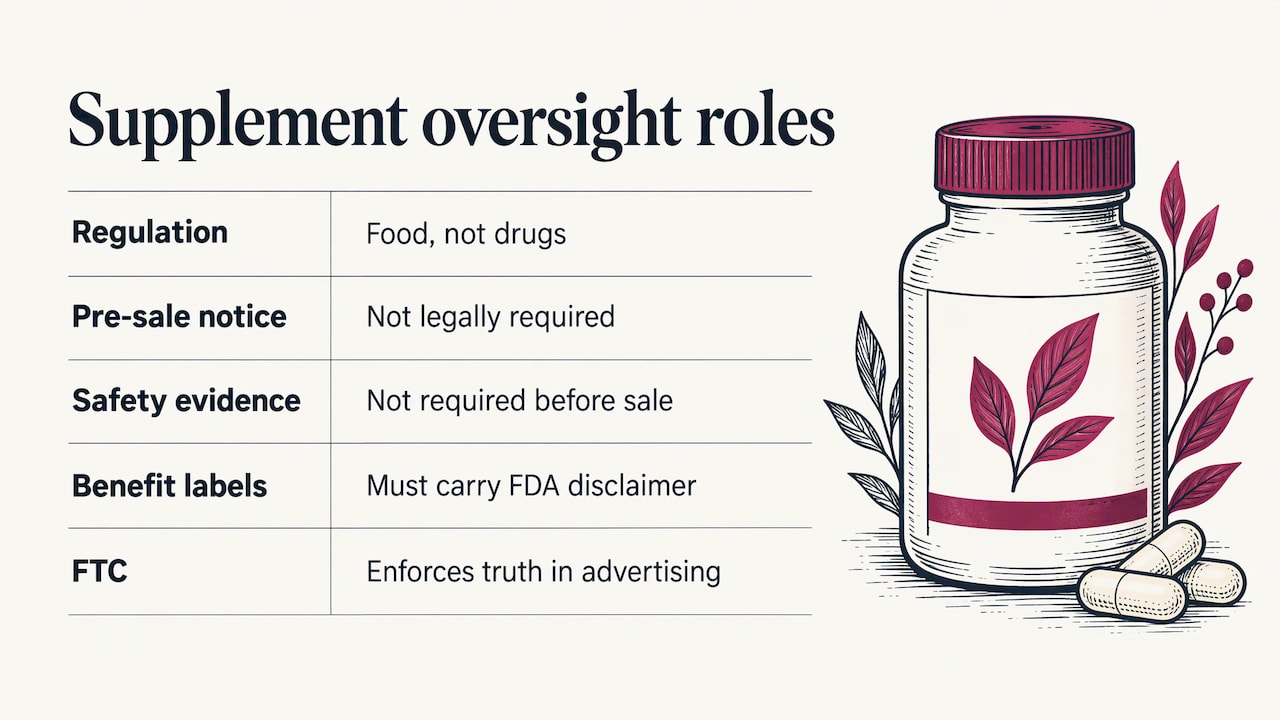
This is the part many Americans get wrong. A 2019 survey found that a majority of Americans overestimate the FDA’s role, assuming it tests supplements before sale or that makers must prove safety and effectiveness. In fact, supplements are regulated as food, not drugs. Manufacturers are not legally required to notify the FDA before release, submit safety or efficacy evidence, obtain label approval or confirm ingredient identity. Labels with benefit statements must carry the FDA disclaimer.
Under the 1994 Dietary Supplement Health and Education Act, as a 2024 review explains, ingredients in the food supply before October 15, 1994 are presumed safe, and the FDA requires makers to report serious adverse events only. The American Botanical Council notes that the FTC enforces truth in advertising, advising that claims rest on clinical trial observations about the specific extraction, composition and formulation.
What that means for you: the label is the starting point, and the maker’s care is the difference. Look for the specific plant, the extract and the amount per serving, not just a proprietary “stress blend.”
How to choose and use an adaptogen well
- Start with your goal. Stress and sleep, daytime focus and memory are different goals, and each plant has its own evidence. The Merck Manual notes the class cannot be studied as a whole: each adaptogen has to be judged on its own, and the more separate claims made for one substance, the less likely they are all true.
- Match the dose to the research. Bacopa and ginseng showed no extra benefit at higher amounts. Ashwagandha research centers on a few weeks of use.
- Change one thing at a time. If you add three products at once, you won’t know what helped or what bothered you.
- Give it weeks. Judge by sleep, reactivity and focus over the course of a month or two, not by the first afternoon.
- Cover the basics. Sleep, daylight, movement and a plan for recovery do much of the work. Our practical plan to recover from stress and daily habits for cognitive function pair well with any supplement.
- Tell your doctor. Especially if you take regular medicines or have a thyroid, liver or blood-sugar condition.
If you are new to all this, safe nootropics for beginners is a good first read.
Why we take a restorative approach
We build around one idea: the nervous system performs best when it is supported, not driven. Many focus products lean on harsh stimulants. They can feel sharp for an hour and leave you frayed by evening, which is the opposite of clarity.
The adaptogen concept points the same way as ours. A broad, balancing, non-stimulating approach is a better fit for people who want to think clearly and stay level, whether that is a professional in back-to-back meetings or a student in exam season.
That is why PRESENCE is made with a restorative formula. It is designed to support neurotransmitter health and resilience against nervous system stress, and to improve mental clarity, emotional balance and social intelligence without harsh stimulants. We design it to build over time, with the aim of lasting gains in nervous system capacity, and to bring mental agility within an hour.
When you judge any product in this space, ask whether it helps your system recover, or only asks more of it.
Calvin
Try PRESENCE
If you want clarity and calm from a restorative formula, PRESENCE is our capsule supplement for exactly that. It is designed to support neurotransmitter health, nervous system resilience and emotional balance without harsh stimulants. You can buy it once or subscribe monthly, from $42 per month, on the PRESENCE product page.
If you want to understand the approach first, our guide to nervous system support explains the foundation, and our look at the best nootropics for focus and concentration walks through the mechanisms.
FAQ
What are adaptogens in simple terms?
They are plants and mushrooms, such as ashwagandha, Rhodiola and ginseng, that are meant to help your body cope with stress and settle back to normal afterward. To qualify, a substance should be nontoxic at normal doses and support the body broadly, not target one symptom.
What is the most powerful adaptogen?
There is no single winner, because each plant has its own evidence and uses. Ashwagandha has the most research on stress and sleep, while Bacopa and Panax ginseng have more data on attention and memory. The best choice depends on your goal and your health.
How long do adaptogens take to work?
Most studies run several weeks. The NIH describes ashwagandha trials of 6 to 8 weeks, so expect gradual change. Some products are designed to give a noticeable effect sooner, but steady results come from consistent use.
Are adaptogens safe to take every day?
For many healthy adults, studied doses have been tolerated, but not for everyone. Ashwagandha has been linked to liver injury in some people and can interact with several medicines. Talk to your doctor first if you take medication, have a liver or thyroid condition, or are pregnant or breastfeeding.
Sources
- UCLA Fielding School of Public Health: what are adaptogens
- European Medicines Agency: reflection paper on the adaptogenic concept
- Cleveland Clinic: What are Adaptogens & Types
- Merck Manual Consumer Version: Adaptogens
- NIH Office of Dietary Supplements: Ashwagandha consumer fact sheet
- Applied Sciences 2025: psychobiotics and adaptogens systematic review
- PMC 2026: mechanisms of selected adaptogens
- Pharmacopsychiatry 2013: Eleutherococcus senticosus and stress management
- Operation Supplement Safety: Brain Health Guide
- PMC: Safety of ashwagandha as a food additive
- Illinois Business Law Journal: dietary supplement regulation
- Journal of Special Operations Medicine: DSHEA overview
- American Botanical Council HerbalGram: ashwagandha regulation