

How to Improve Empathy Naturally: Habits That Work
You can improve empathy naturally, and the evidence says it responds to practice. The habits that work are simple: listen without planning your reply, ask open questions instead of guessing, name your own emotions, and check your read of other people. A calm, well-supported nervous system helps you do all of that more consistently. This guide covers the habits, the research behind them, how to get better at reading social cues, and what supplements can and cannot do.
TL;DR
- Empathy is a skill with several parts, and training programs show moderate effects across randomized trials.
- The most reliable daily habits are focused listening, open-ended questions, and asking for feedback.
- Reading social cues improves when you notice body language, notice your own reaction, and then ask rather than assume.
- No pill replaces practice. We designed PRESENCE to support the nervous system so you can practice from a calmer, clearer place.
- If you take medication or have a health condition, talk to your clinician before adding any supplement.
Table of Contents
- What empathy actually is
- Can you really improve empathy?
- Daily habits that build empathy
- How to get better at reading social cues
- Why a calm nervous system matters
- What supplements can and cannot do for empathy
- Our perspective
- A simple four-week plan
- Support your practice with PRESENCE
- FAQ
- Sources
What empathy actually is
Empathy is not one thing. The Greater Good Science Center at UC Berkeley separates affective empathy from cognitive empathy: the first is the feeling we get in response to others, the second is understanding another person’s perspective. Mayo Clinic Press describes the same two kinds, feeling someone’s joy or pain versus inferring how a situation affects them.
Two details matter for practice.
First, empathy keeps a boundary. Researchers Tania Singer and Olga Klimecki write that you feel with someone without confusing yourself with them. Without that self-other distinction, what you have is emotional contagion, not empathy. If other people’s moods flood you, the goal is not to feel more. It is to stay steady enough to understand.
Second, understanding is not the same as helping. The APA Dictionary of Psychology notes that empathy does not, by itself, entail wanting to help. Stanford’s Jamil Zaki, cited by Harvard’s professional education team, describes three parts: identifying what others feel, sharing it, and wanting to improve their experience. Most people are stronger on one part than the others. Knowing which one is yours tells you where to start.
Can you really improve empathy?
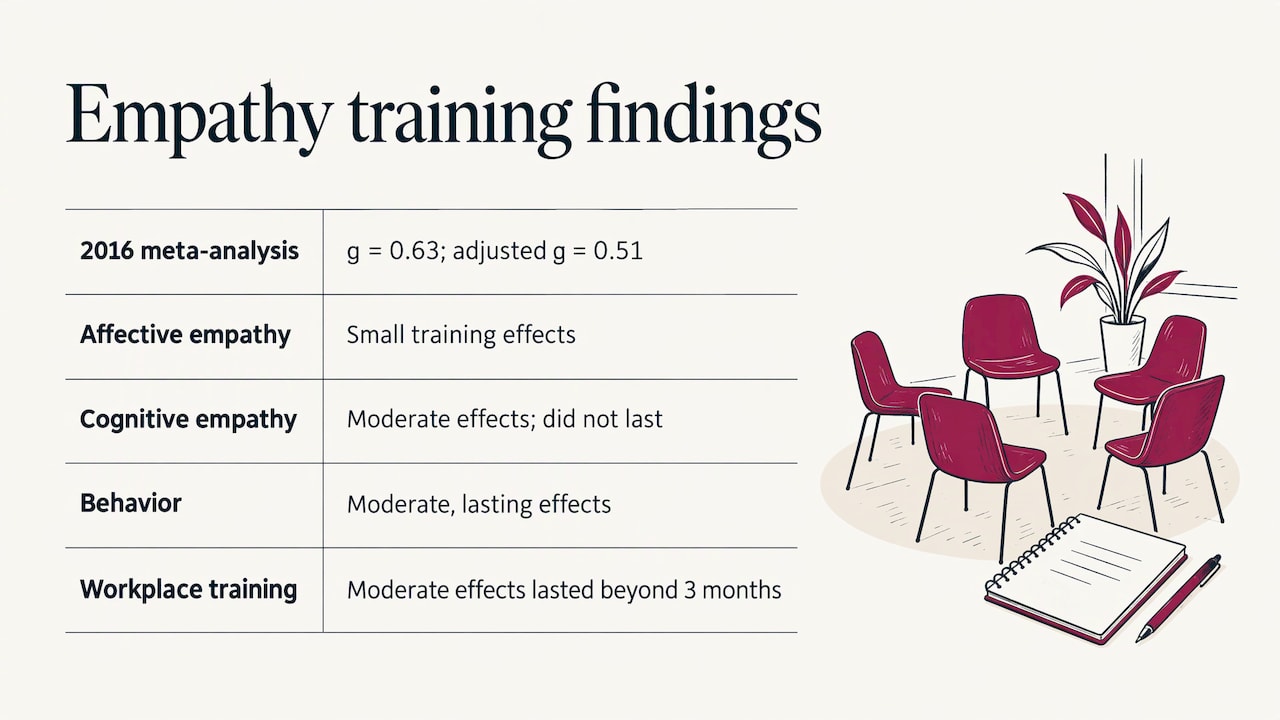
Yes, with realistic expectations. A 2016 meta-analysis of 18 randomized trials with 1,018 participants found that empathy training works overall, with a medium effect (g = 0.63, adjusted to 0.51 for possible publication bias).
A 2024 review of 110 studies is more nuanced. It found that training produced small effects on affective empathy and moderate effects on cognitive empathy that did not last, but moderate, lasting effects on behavior. Approaches built around other people, such as group work and real interaction, were the most effective. In plain terms: what sticks is changing what you do with people, not only what you feel.
The results also hold at work. A 2024 review of 50 workplace studies found that emotional competence training had moderate effects that lasted beyond three months.
Belief plays a part too. Research by Schumann and Zaki, described in the APA Monitor, found that people put in more empathic effort with someone different from them mainly when they believe empathy can be developed. Seeing empathy as a trainable skill is the first step. If you have young children, mindfulness practices for young children are one way to model the same attention and self-regulation habits at home.
Daily habits that build empathy
Listen the way you would want to be heard
UC Berkeley’s Greater Good in Action program outlines a five-step listening practice: affirm the person, stay curious, hold negative emotions without rushing to fix them, use engaged body language, and take turns. It also names the habits that get in the way: composing your reply while the other person talks, overthinking, judging, and glancing at your phone.
A simple way to start this week:
- Pick one conversation a day, with a partner, colleague, or friend.
- Put the phone out of sight.
- Wait a full beat after they finish before you speak.
- Reflect back one thing you heard, in your own words.
Ask instead of guessing
The same Berkeley program describes perspective-getting: asking open-ended questions and listening to the answer gives more accurate insight than guessing what someone thinks, and it improves how you feel about that person. Try “What was the hardest part of that for you?” in place of “That must have been rough.”
Name your own emotions first
Harvard’s professional education team recommends naming your emotions, asking people around you for feedback, and reading literature with complex characters. Each one builds a different muscle. Naming feelings gives you the vocabulary to recognize them in others. Feedback shows you your blind spots. Fiction rehearses taking other minds seriously.
Practice compassion or mindfulness
A randomized study of eight weeks of cognitive-based compassion training found improved accuracy on a test of reading emotions from the eyes compared with a health discussion control, along with changes in brain regions tied to social understanding. A meta-analysis of mindfulness programs in healthy people also found a significant improvement in empathy. Even a few minutes a day is a reasonable starting point, and longer programs tend to be where the studies see results.
Be selective with apps
Digital tools are convenient, but the evidence is thinner. A 2026 meta-analysis of 24 trials found a small overall effect of digital interventions on empathy that shrank after adjusting for publication bias. Use apps as a reminder to practice, and put the real work into live conversations.
How to get better at reading social cues
Reading cues is the cognitive side of empathy, and it does not require mind reading. Alexandra Main of UC Merced told the APA Monitor that empathy in daily life is more about actively appreciating someone’s point of view than about guessing their thoughts. She suggests open-ended questions and nonverbal cues such as nodding to encourage people to keep sharing.
A useful loop, drawn from Harvard Health’s summary of the topic, is that empathy involves attending to words and body language, noticing your own internal reaction, and asking about feelings. Doing this regularly refines how accurately you sense others.
Turn it into three moves:
| Move | What you do | Example |
|---|---|---|
| Notice | Watch tone, pace, posture, and what is left unsaid | Their answers got shorter after you mentioned the deadline |
| Hypothesize | Hold your read loosely and note your own reaction | “Maybe they feel pressured. I feel a bit tense too.” |
| Check | Ask an open question and listen | “How are you feeling about the timeline?” |
The third move is what makes a cue-reading habit accurate. A cue is a prompt to ask, not a verdict. If you want to go further on the social side, our guide on how to improve social intelligence covers it in depth, and improving social confidence helps when nerves are what keep you from engaging.
Why a calm nervous system matters
Empathy is hard to practice when you are depleted. Mayo Clinic Press has a whole piece on empathy running on empty, and anyone who has tried to listen well after a bad night or a stressful day knows it. When you are stressed, attention narrows to your own load, and you listen to reply, not to understand.
Sleep, movement, time outside, and recovery breaks are the foundation. They make the listening and perspective habits above easier to carry out. Our own approach to nutritional support starts from the same idea, and we write about it in nootropics for mood and mental health support.
What supplements can and cannot do for empathy
Supplements marketed for emotional intelligence or interpersonal awareness deserve a clear-eyed look, so here is what the research actually tests.
Most of the controlled work on social cognition involves single compounds in lab settings, not everyday formulas:
- Oxytocin. In one study, intranasal oxytocin improved empathic accuracy mainly in people who were less socially proficient. A meta-analysis of 17 trials found no significant effect on emotion recognition and only tentative promise. Oxytocin is a hormone given in research settings, not something you get from a capsule.
- Tryptophan and 5-HTP. A double-blind trial in 77 healthy adults found no significant effect of four weeks of tryptophan on emotion recognition, though some neural and moral-judgment measures shifted.
- Stress hormones. A review of hormone studies found emotional accuracy seemed to improve when oxytocin rose and decline when cortisol or testosterone rose, which fits the idea that physiological calm and social perception are linked.
The takeaway is practical. No ingredient has been shown to install empathy. What a well-designed formula can reasonably aim for is to support the conditions in which practice works: steady mood, clear thinking, and resilience to nervous system stress.
Using any supplement safely
Talk with your doctor or pharmacist before starting a supplement if you are pregnant or breastfeeding, take prescription medication, or manage a health condition. Follow the label, start with the recommended serving, and stop and check in with a clinician if something feels off. Supplements work alongside habits and professional care, and they do not stand in for treatment of anxiety, depression, or other conditions.
Our perspective
We built PRESENCE around a simple observation: people rarely lack the wish to connect. They lack the bandwidth. When your nervous system is running hot, listening well, reading a room, and staying warm under pressure all get harder.
That is why we took a restorative approach. Many nootropics push the system with harsh stimulants. We chose ingredients selected to nurture the nervous system, supporting neurotransmitter health and resilience against stress, so that clarity and emotional balance can build over time instead of spiking and fading.
PRESENCE is not a shortcut around the habits in this article. It is designed to sit under them. Listening, asking open questions, and checking your read of people are what build empathy. We want you to do those things from a calmer, more articulate state of mind.
Our formula is designed to support social intelligence, mental clarity, and emotional balance. Give your habits a steady foundation and let them compound.
Calvin
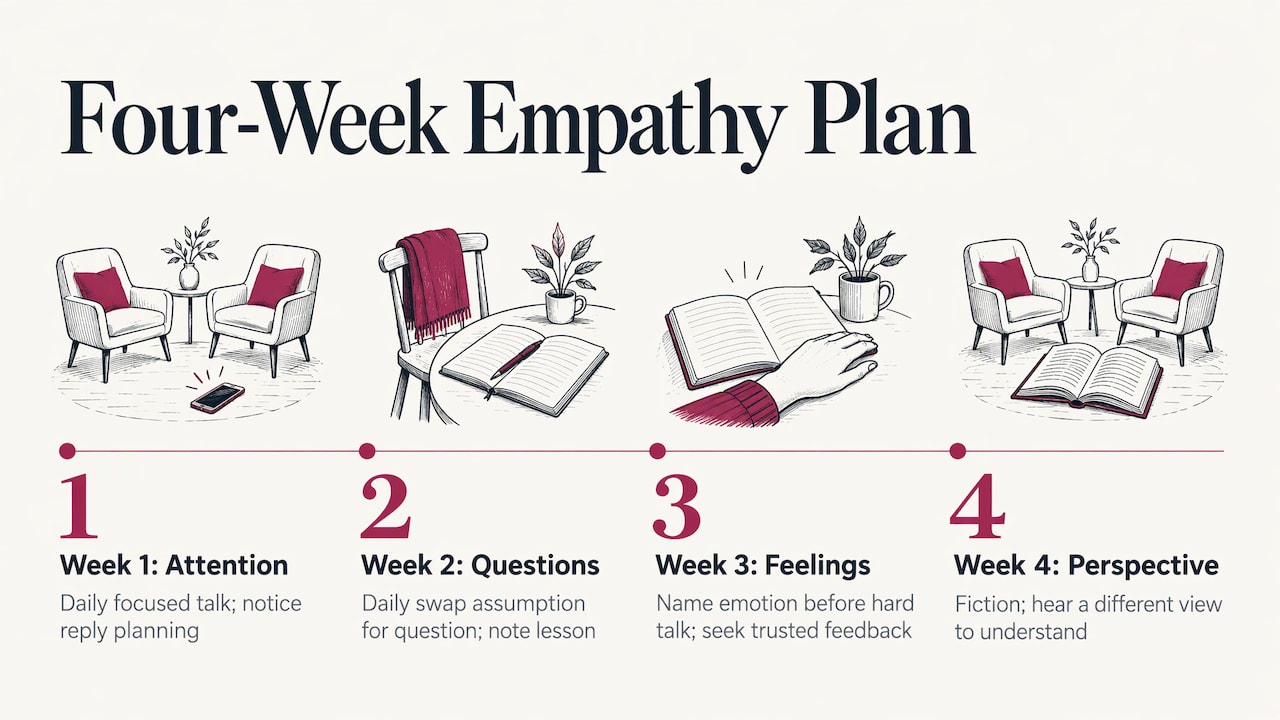
A simple four-week plan
Putting it together keeps this from staying theoretical.
Week 1: Attention. One distraction-free conversation a day. Notice when you start composing your reply.
Week 2: Questions. Replace one assumption a day with an open question. Write down what you learned that you would have guessed wrong.
Week 3: Feelings. Name your own emotion before a hard conversation. Ask one trusted person for feedback on how you come across.
Week 4: Perspective. Read a chapter of fiction a few evenings, and have one conversation with someone whose view differs from yours, aiming to understand it, not answer it.
Because the research shows lasting gains in behavior more than in feeling, track what you do, such as questions asked and conversations held, instead of how empathetic you feel.
Support your practice with PRESENCE
If you want a calmer base for these habits, PRESENCE is our restorative nootropic capsule, formulated without harsh stimulants and designed to support mental clarity, emotional balance, and social intelligence. It is available as a one-time purchase or a monthly subscription, from $42 per month.

You can see the details and choose an option on the PRESENCE product page.
FAQ
How can I become more empathetic as an adult?
Treat it as a skill. Practice focused listening, ask open-ended questions, and name your own emotions. Reviews of randomized trials show medium overall effects from empathy training, and behavior changes tend to last the longest.
How do I get better at reading social cues?
Notice tone, posture, and pacing, then check your interpretation with an open question instead of assuming. Researchers describe everyday empathy as actively appreciating someone’s point of view, not mind reading. Repeating that loop regularly sharpens accuracy.
Do empathy or emotional intelligence supplements work?
No ingredient has been shown to create empathy on its own. Controlled studies of compounds such as oxytocin and tryptophan show limited or tentative effects on social cognition. Our formula is designed to support the nervous system and the clarity you need to practice empathy habits.
What if I feel too much of other people’s emotions?
That is closer to emotional contagion than to empathy, which keeps a clear line between you and the other person. Naming your own feelings, pausing before you respond, and building recovery time into your day help. If it is overwhelming, a licensed therapist can help.
Sources
- Empathy Definition, Greater Good Science Center, UC Berkeley
- Empathy and compassion, Current Biology
- Empathy on empty, Mayo Clinic Press
- APA Dictionary of Psychology: empathy
- How to Improve Your Emotional Intelligence, Harvard DCE Professional
- The efficacy of empathy training: a meta-analysis
- Categories of training to improve empathy: a systematic review
- Training emotional competencies at the workplace
- Cultivating empathy, APA Monitor
- Listen with Empathy, Greater Good in Action
- Practice Perspective Getting and Giving, Greater Good in Action
- Compassion meditation enhances empathic accuracy
- Effectiveness of mindfulness-based interventions on empathy
- Effectiveness of digital interventions for enhancing empathy
- Want to feel more connected? Practice empathy, Harvard Health
- Oxytocin Selectively Improves Empathic Accuracy
- Intranasal oxytocin, social cognition and neurodevelopmental disorders
- Tryptophan-enriched diet or 5-hydroxytryptophan and social cognition
- Role of oxytocin, cortisol and testosterone in emotional accuracy