

How to Focus During Exams: A Practical Plan
Focus during an exam is built before you sit down and protected while you are in the chair. The plan that works has three parts: sleep and routine in the days before, a calm, low-effort hour before the test, and a short reset you can use the moment your mind drifts. A steady nervous system underpins all three, and that is the idea behind how we approach focus at Supernal.
This guide walks through each part in order, with advice from US university learning centers and a few studies, so you can use it whether your exam is tomorrow or next month.
TL;DR
- Sleep and anxiety predicted exam grades in a 2025 study of 51 students, so protect both before anything else.
- Study in short blocks with breaks, and skip the all-nighter: universities including Minnesota and Northwestern warn against it.
- In the hour before the exam, do something relaxed and non-thinking, then write down your goals and worries.
- When focus slips mid-exam, move to another question, breathe slowly and ground yourself in the present moment.
- If you want daily support for a calm, clear nervous system, PRESENCE is our restorative option, without harsh stimulants.
Table of Contents
- Why focus breaks down during exams
- The week before: the base layer
- The night before and the morning of
- The hour before the exam
- During the exam: a step-by-step routine
- When your focus slips mid-exam
- Where daily nervous system support fits
- Our perspective
- PRESENCE for exam season
- FAQ
- Sources
Why focus breaks down during exams
Most students assume a wandering mind is a character flaw. The evidence points to two ordinary causes: poor sleep and anxiety.
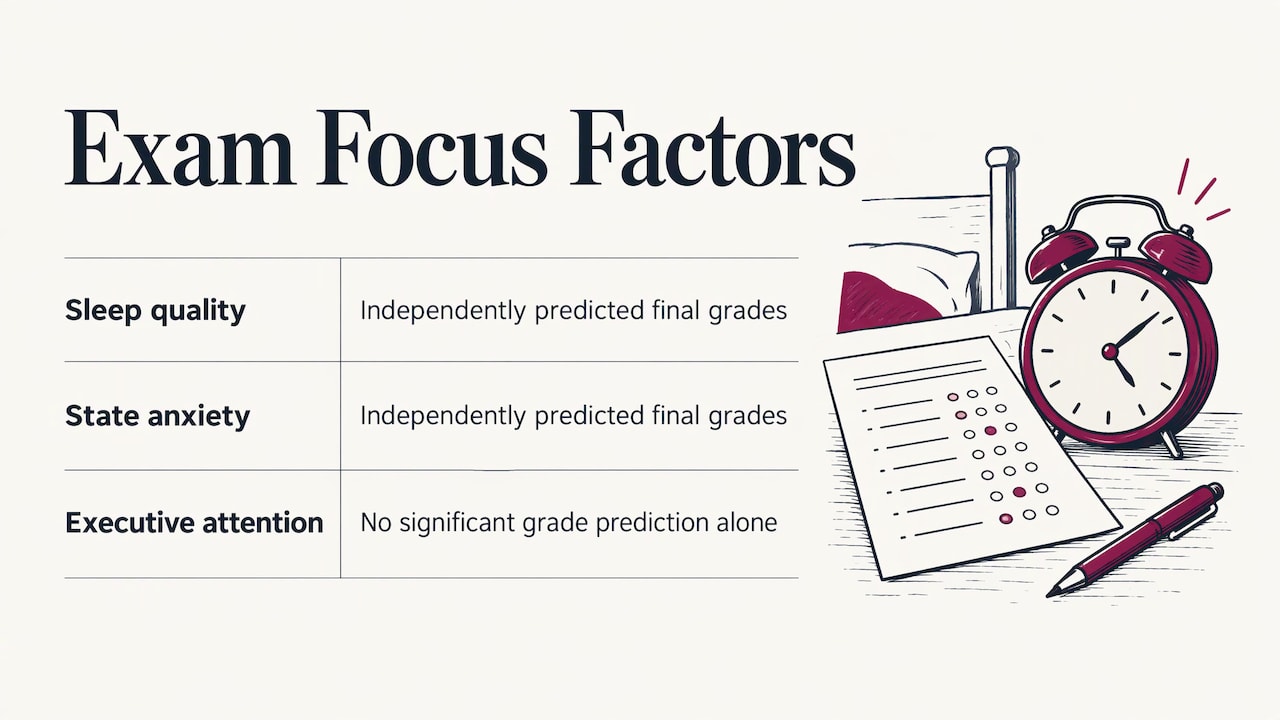
A 2025 peer-reviewed study of 51 medical, law and economics students found that sleep quality and state anxiety (how anxious you feel in the moment) each independently predicted final exam grades. Executive attention, the skill most people think of as “focus”, did not significantly predict performance on its own. In plain terms: how rested and how calm you are mattered more than how well you can concentrate on a good day.
That is useful, because sleep and anxiety are both things you can change. It also explains why willpower alone fails. If your body is tired or in a stress response, forcing attention is like pushing a car with a flat tire.
The University of North Carolina’s Learning Center adds another trigger: students with high perfectionism and high self-criticism tend to have more test anxiety and do worse. Keep that in mind when you set your goals later in this guide.
The week before: the base layer
Sleep like it is part of studying
The University of Minnesota’s Effective U advises a full night of 7 to 9 hours in the days before the exam and no all-nighters. Northwestern’s academic support office agrees that cramming late can do more harm than good if it costs you sleep, and notes that short daytime naps can help.
There is also a memory reason. UC Berkeley’s student wellbeing team, citing sleep researcher Miyatsu, explains that sleep is when the brain consolidates what you learned that day, replaying it and strengthening it. An extra hour of review at 2 a.m. can cost you the very retention you are chasing.
Break up your study sessions
Studying four or five hours straight is the least focused way to study. Effective U recommends splitting sessions up and using the Pomodoro Technique, which alternates short work sprints with breaks. Indiana University’s Student Health Center suggests a 10-minute break about once an hour, ideally away from your study spot, and a steady pace rather than cramming.

Oregon State University’s Academic Success Center goes further: vary your study method every 20 to 30 minutes to refresh attention, use a fidget toy as an energy outlet, and try studying beside another focused person for accountability.
A simple weekday template:
- Work for 25 to 45 minutes on one task, phone out of reach.
- Take a 5 to 10 minute break that involves moving, not scrolling.
- Switch the method for the next block: from reading to practice questions, for example.
- Repeat three or four times, then stop.
For more tactics on the studying side, see our guide on how to stay focused while studying.
Use a 30-minute retrieval routine
UC Berkeley recommends an end-of-day routine: spend about 30 minutes trying to recall the day’s material from memory, then check what you got right and what you missed. Retrieval practice makes exam-day recall feel familiar, which lowers the stress that scatters attention.
Rehearse the conditions
Mayo Clinic suggests studying in the same place, or a similar place, where you will take the test, setting up a consistent pretest routine and practicing relaxation techniques daily so they feel automatic on test day. The key word is daily. A breathing technique you first try in the exam hall is far harder to use than one you have practiced thirty times.
If you want a simple tool for those daily breathing moments, there are ways to improve concentration with mindful breathing as part of a regular routine.
The night before and the morning of
Keep this part boring. The goal is to arrive rested, fed and unhurried.
- Sleep. Aim for the 7 to 9 hours Effective U recommends. If you cannot fall asleep, lying calmly in the dark still beats getting up to study.
- Breakfast. Effective U suggests a slow-energy breakfast such as oatmeal, almonds and fruit, while limiting caffeine and sugar, because both can set up unpredictable crashes.
- Movement. Light exercise helps. A 2020 study of 68 sixth graders found that a 10-minute moderate activity break before a math test did not impede performance, so a short walk before the exam is a safe habit. Northwestern also suggests considering exercise before the exam.
- Arrival. Get there early and pick a seat away from the door to reduce distractions, as Effective U advises.
On the caffeine point: if you are already a coffee drinker, the exam is not the day to change your routine drastically or to double your usual amount. If jitters are a problem for you, our piece on how to avoid caffeine jitters and keep your focus explains why.
The hour before the exam
This is where many students make things worse by frantically reviewing notes. Indiana University’s health center recommends the opposite: engage in relaxed, “non-thinking” activity during the hour before, such as soothing music, deep breathing or mindfulness.
Two more evidence-backed moves:
- Write it out. Northwestern reports that research shows writing down your thoughts and feelings about an exam beforehand can reduce test anxiety and improve performance. Spend five minutes on it.
- State concrete goals. Northwestern also recommends naming achievable goals just before the exam starts. “Read every question twice and answer the ones I know first” beats “get an A”. Remember the UNC finding on perfectionism: aim for doing well rather than perfectly.
If you notice your heart racing, our guide to how to calm your nerves naturally covers what helps fast and what helps over time.
During the exam: a step-by-step routine
Once the paper is in front of you, focus becomes a set of small decisions.
1. Plan your pacing in the first minute
CCRI’s test-taking guidance says to find out how many questions you have and how much time, so you can pace yourself. Do the easier questions first and skip the ones you are unsure of, then come back.
2. Read directions twice
Indiana’s guidance is to read the exam directions twice when they are handed out. Misreading a prompt wastes more time than any distraction.
3. Watch your own paper
CCRI advises focusing on your own test instead of how quickly others finish. Someone turning in early tells you nothing about your answers.
4. Breathe on a schedule
Indiana recommends checking your breathing and practicing mindful breathing throughout the test. Pick a trigger: every time you turn a page, take one slow breath out. It costs two seconds.
When your focus slips mid-exam
A blank mind or a song looping in your head is common, and it is fixable in under a minute. Try this sequence:
- Move on. Skip to another question. The fastest way to break a stuck loop is to stop feeding it. UNC suggests the thought, “It’s okay if I can’t answer this question; I can answer another question instead.”
- Ground yourself. UNC also suggests stating plainly where you are and when, for example: “I am sitting at a desk. It is 2:00 pm on Tuesday.” This pulls attention away from future and past worries.
- Return to baseline. Indiana advises deep breathing and coping statements such as “I don’t have to rush, it is OK to take time to figure out what I need to do.” Catch anxious self-talk and replace it with “Take your time.”
- Reset your senses. A tip that circulates among students is to look elsewhere in the room for 20 seconds and sip cold water, then return to the page. It is low-risk and takes almost no time.
If you have ADHD, dyslexia or another learning disability, Mayo Clinic notes that you may be entitled to accommodations such as extra time, a less distracting room or questions read aloud. Ask your school’s disability services office well before exam week, not the day of.
Where daily nervous system support fits
Everything above works on the habits and the moment. There is a third layer: the baseline state of your nervous system. Sleep loss and anxiety were the two factors that predicted grades in the study above, and both are tied to how well your body handles stress over weeks, not just on exam morning.
That is the layer we focus on at Supernal. If you want to understand it, start with nervous system regulation and how to remain calm under pressure. If you are new to the category, what nootropics actually do explains it in plain terms, and our breakdown of nootropics for focus and concentration goes into mechanisms.
The practical point for students: a restorative approach is something you build over weeks ahead of the exam, alongside sleep and study blocks, rather than something you reach for in the final hour.
Our perspective
Students tend to ask us for a trick: one thing that makes them focused for two hours. We understand why. But exam focus is rarely a single-switch problem. It is a nervous system that is either settled enough to pay attention or too taxed to do it.
That is why we built PRESENCE around a restorative approach rather than stimulation. Our formula is designed to support neurotransmitter health and resilience against nervous system stress, with the aim of a clearer, calmer mental state that develops over time. We chose not to rely on harsh stimulants, because jitters and a crash are the opposite of what you want at a desk.
Pair it with the basics in this guide: sleep, short study blocks, a calm hour before the test and a breathing habit. Start well ahead of exam week so the routine is already familiar when it counts.
Calvin
PRESENCE for exam season
PRESENCE is our nootropic supplement in capsule form, made to support mental clarity, emotional balance and resilience against nervous system stress without harsh stimulants. It is available as a one-time purchase or a monthly subscription, from $42 per month. You can see the full details on the PRESENCE product page.
Before starting any supplement, talk with your doctor or pharmacist if you are pregnant or nursing, take medication or have a medical condition.
FAQ
How can I focus during an exam when I feel anxious?
Slow your breathing first, then ground yourself with a plain statement of where you are and what time it is. Replace catastrophic thoughts with practical ones, such as moving to a different question. UNC and Indiana University both recommend these steps, and practicing them daily beforehand makes them work under pressure.
Should I drink coffee before an exam?
Stick to what your body already knows. Effective U advises limiting caffeine and sugar on exam day because of unpredictable crashes, and a slow-energy breakfast like oatmeal, almonds and fruit is its suggestion instead. If coffee makes you jittery, keep it light or skip it.
How long should I study before taking a break?
The university guidance ranges from short Pomodoro-style blocks of 20 to 30 minutes to about an hour with a 10-minute break. Choose the length where you can stay on task, and vary your method between blocks to keep attention fresh.
Is an all-nighter ever worth it?
The research and university guidance point the other way. Minnesota and Northwestern both warn against it, and Berkeley explains that sleep consolidates what you learned. Use that last night for light review and a full 7 to 9 hours of sleep.
Sources
- Who Performs Best Under Pressure? The Role of Sleep, Anxiety and Executive Attention (MDPI, 2025)
- Concentration & Distraction, Oregon State University Academic Success Center
- Before the Test, University of Minnesota Effective U
- Test-Taking Strategies, Northwestern University
- Effects of an Acute Physical Activity Break on Test Anxiety (MDPI, 2020)
- Test anxiety: Can it be treated? Mayo Clinic
- Test Taking Strategies, CCRI
- Test Anxiety, Indiana University Health Center
- Test Anxiety, UNC Learning Center
- Tackle exam season with science-backed study tips, UC Berkeley