
How to Think Faster Naturally: What Works and What Doesn’t
You can think faster naturally by protecting the basics that set your processing speed (sleep, movement, stress levels), by training attention on one task at a time, and by changing how you make decisions so you stop spending time where it adds nothing. Speed is rarely about forcing your brain to go harder. It is mostly about removing what slows it down.
This guide walks through each lever in order of impact, shows what the research behind it says, and explains where a restorative nootropic fits once the foundations are in place.
TL;DR
- Sleep and exercise come first: aim for seven to eight hours a night and 150 minutes of aerobic activity a week.
- Train focus with single-tasking and mindfulness, and use a one-second pause plus slow breathing to reset under pressure.
- Match thinking time to the stakes. Decide fast when a mistake is cheap, slow down when it is costly.
- Be wary of nootropics sold as drugs or stimulants. Choose transparent, restorative formulas and talk to a clinician if your thinking changes.
- Persistent slowing, memory problems or brain fog that lasts weeks deserves a conversation with your doctor.
Table of Contents
- What “thinking faster” actually means
- Start with sleep, because everything else rests on it
- Move more: the most reliable brain upgrade
- Train attention, not just speed
- Reset under pressure: the pause and the breath
- Decide faster without deciding worse
- What slows you down without you noticing
- Where nootropics fit, and how to choose safely
- Our perspective
- Try a restorative approach with PRESENCE
- A simple seven-day plan to start
- When slower thinking is a reason to see a doctor
- FAQ
- Sources
What “thinking faster” actually means
People use the phrase for three different things, and the fix depends on which one you mean.
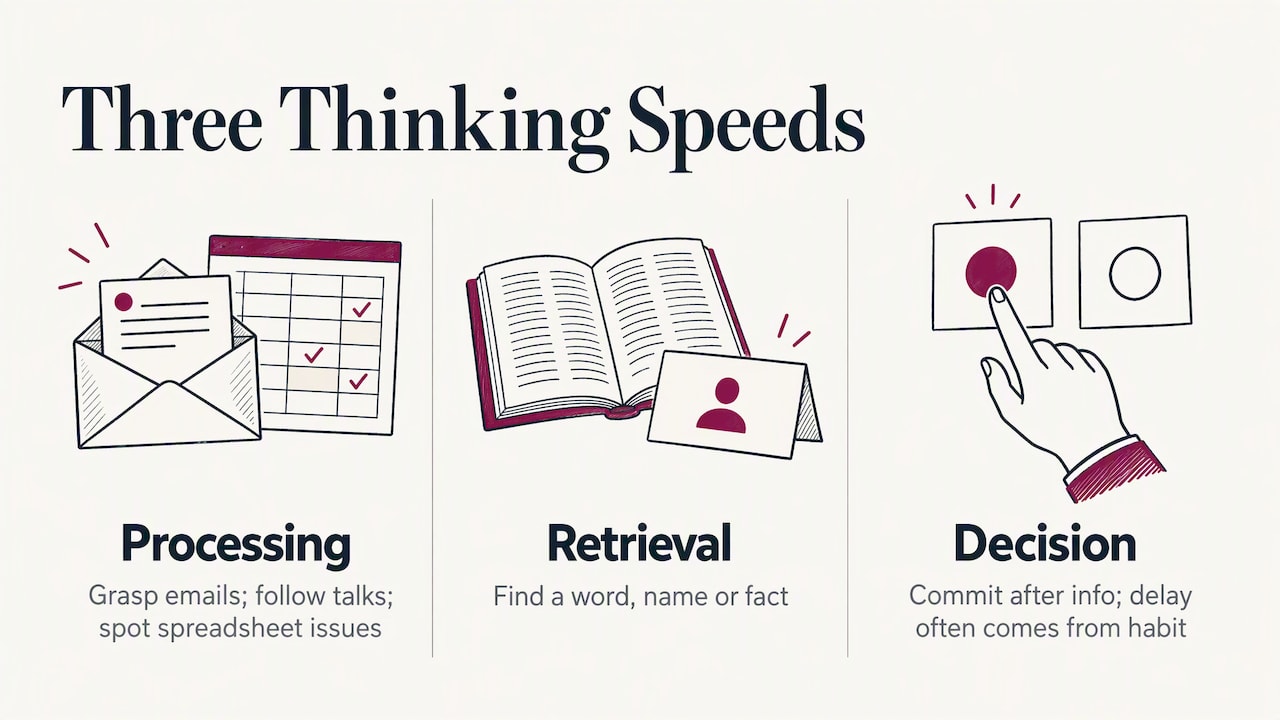
Processing speed is how quickly you take in information and make sense of it: reading an email and grasping the point, following a fast conversation, spotting the problem in a spreadsheet.
Retrieval speed is how quickly the right word, name or fact comes to you. That is the “tip of the tongue” problem, and it gets worse when you are tired or anxious.
Decision speed is how long you take to commit once you have the information. This is the one most people can improve fastest, because much of the delay is habit rather than biology.
A person who feels “slow” in meetings may have a retrieval problem caused by stress. A person who feels slow at work overall may have a sleep debt. Name the problem first, then pick the lever.
Start with sleep, because everything else rests on it
If you change only one thing, change this. The CDC describes sleep as essential to health, puts average adult needs at about 7 to 8 hours per night, and links insufficient sleep to deficits in cognition, memory and learning. The same source argues sleep deserves to be treated as a pillar of health equal to diet and exercise.
Harvard Health adds that sleep helps reduce stress hormones and clear proteins that can injure the brain. Slow thinking after a short night is not weakness. It is your brain doing less maintenance than it needed.
Practical moves that tend to help:
- Keep a fixed wake time, even on weekends.
- Move your body during the day. The CDC notes that exercise during the day, even a 10-minute walk, can improve sleep.
- Treat your bedroom as a sleep tool: dark, cool, quiet.
- Some people also look into the environment around the bed, for example grounding sheets and sleep quality research, as part of a wind-down routine.
Note that alcohol is on Harvard’s list of things that undermine concentration, so a late drink that “helps you relax” can quietly cost you the next day’s sharpness.
Move more: the most reliable brain upgrade
Harvard Health recommends 150 minutes per week of aerobic exercise, noting that exercise can promote brain chemicals, reduce stress and improve sleep. That is about 30 minutes, five days a week, and it does not have to be intense. A brisk walk counts.
A simple way to make it stick:
- Attach movement to something you already do: a walk after lunch, a call taken on foot.
- Start with 10 minutes. Consistency beats ambition.
- Schedule the hardest thinking task for after you move, when you tend to feel more alert.
The same Harvard guidance points to a Mediterranean-style way of eating as supportive of brain health. You do not need a special plan: vegetables, legumes, fish, olive oil and whole grains, with less ultra-processed food, is the pattern to aim for.
Train attention, not just speed
A lot of “slow thinking” is split attention. Your brain is fast at one thing and slow at switching. Every notification forces a switch, and each switch leaves some of your attention behind.
Harvard Health says you can strengthen focus through mindfulness, single-task attention exercises and progressively challenging cognitive training. Harvard-affiliated neuropsychologist Kim Willment notes that mindfulness, which means focusing on the present moment, can help rewire the brain to strengthen attention in everyday life.
A practical routine:
- Single-task blocks. Work for 25 to 45 minutes on one thing with notifications off, then take a real break.
- Five minutes of mindfulness. Sit, follow your breath, and each time your mind wanders, return it. That return is the exercise.
- Raise the difficulty gradually. Learn a language, an instrument or a new software tool. Novelty makes the brain work harder than familiar puzzles do.
One honest caution about brain games. U.S. government agencies including the ACL, NIH and CDC state that no brain game or specific mental exercise has been proven to directly prevent or slow dementia, although keeping the mind active is linked to reduced risk. So pick challenging activities you enjoy and will keep doing, rather than one app promising to double your speed.
For workplace habits in more detail, see our guide on how to stay focused at work.
Reset under pressure: the pause and the breath
When you are put on the spot, your instinct is to rush. That usually makes you slower, because stress floods the system and thoughts scatter.
A 2025 experiment found that a one-second pause before judging improved accuracy with less mental workload, while a longer 2.5-second wait increased irritation. The takeaway is a short reset, not a long stall. One beat, then answer.
For the body side, the American Psychological Association describes slow, rhythmic breathing and counting backwards as ways to manage physiological arousal and interrupt racing thoughts. A usable version:
- Breathe in through your nose for four counts.
- Breathe out slowly for six counts.
- Repeat three times while listening to the question all the way through.
- Answer the main point first, then add detail if needed.
If pressure moments are your main problem, our pieces on remaining calm under pressure and calming your nerves naturally go deeper.
Decide faster without deciding worse
This is where many people gain the most speed. The Kauffman Foundation’s decision guide recommends matching thinking time to the consequences of error: decide quickly when a poor outcome has little impact and spend more time when the downside is large.
It also makes a point worth printing out. Most of the value in decision-making comes from sorting options against your goals and values. Once you have a set of acceptable options, extra time spent choosing among similarly good ones usually adds little accuracy.
Turn that into rules:
| Situation | Stakes | How long to spend |
|---|---|---|
| Which restaurant, which email draft | Low and reversible | Pick within a minute |
| Which tool to use for a project | Medium | Compare against two or three criteria, then commit |
| Hiring, a major purchase, a contract | High and hard to undo | Take real time, get input, sleep on it |
Two habits make this work. First, write your criteria before you look at options. Second, set a “good enough” threshold in advance, so the first option that clears it wins.
What slows you down without you noticing
Before adding anything new, check for drags. Harvard Health lists underlying conditions, some medications, alcohol and information overload as things that can undermine concentration, and notes that some medications can slow processing speed.
A quick audit:
- Sleep debt. Are you regularly under seven hours?
- Stress load. Do you feel wired and tired at once?
- Inputs. How many tabs, chats and feeds are open while you work?
- Substances. Alcohol timing, caffeine late in the day, any new medication.
- Blood sugar and meals. Long gaps followed by heavy lunches often show up as an afternoon slump. Our guide to afternoon brain fog covers it.
Fixing two of these usually beats any single trick.
Where nootropics fit, and how to choose safely
A nootropic is a supplement or compound taken to support thinking, focus or mood. It works best as a layer on top of sleep, movement and good habits, never as a replacement for them. Our explainer on what nootropics actually do sets realistic expectations.
The category is uneven, and safety is the first filter. In 2025 the FDA cautioned that tianeptine is not an FDA-approved drug for any medical use in the U.S. and has been linked to severe adverse events, including seizures and loss of consciousness, even when sold as a nootropic. In a 2019 warning letter, the FDA said one seller’s Alpha GPC and piracetam products were drugs intended to treat diseases and not generally recognized as safe and effective for those uses.
Those are the products to avoid. What to look for instead:
- A full, readable ingredient list with no hidden proprietary blends.
- Claims about supporting the nervous system, not treating disease.
- No reliance on heavy stimulant loading that leaves you jittery, then flat.
- A clear way to buy directly from the maker. Our guide on where to buy nootropics online safely explains how to check.
- Sensible starting steps if you are new, covered in safe nootropics for beginners and the notes on nootropics side effects.
If you take prescription medication, are pregnant or nursing, or have a medical condition, check with your doctor or pharmacist before starting any supplement. Women reading this may also want our piece on whether women can take nootropics safely.
Our perspective
Most nootropics try to make you faster by pushing harder: more stimulation, more intensity, a quick spike. We think that gets the problem backwards. Fast, clear thinking is what a well-supported nervous system does naturally when it is not overloaded.
That is why we built PRESENCE as a restorative formula rather than a stimulant. It is designed to support neurotransmitter health and resilience against nervous system stress, so clarity, calm and social ease can build over time instead of arriving as a short jolt.
We also say plainly that no capsule replaces sleep, movement and good focus habits. PRESENCE is designed to work alongside them, giving your nervous system better raw material for the habits you are already building.
Calvin
Try a restorative approach with PRESENCE
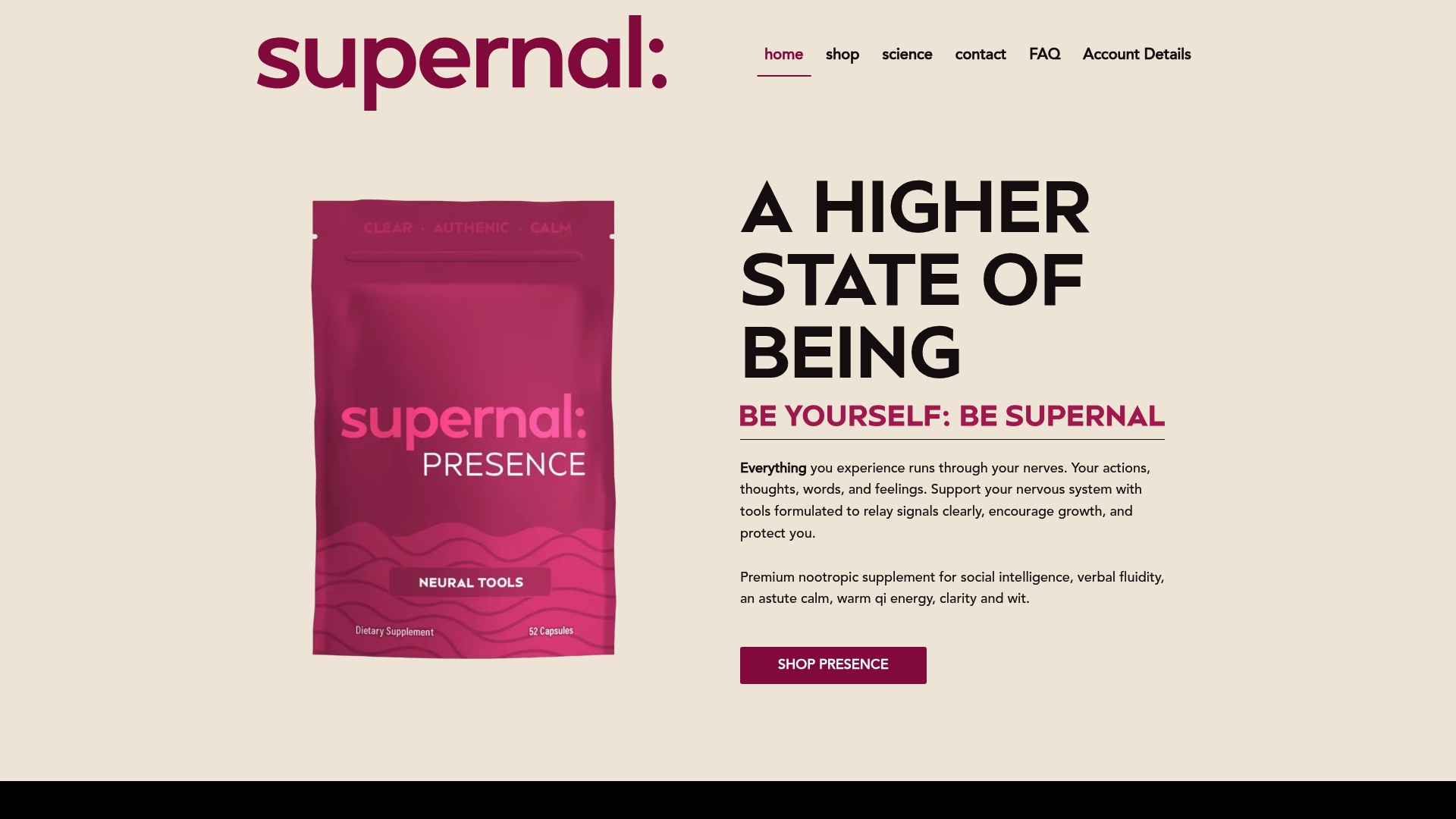
If you have the basics in place and want extra support for mental clarity and emotional balance, PRESENCE is our capsule formula, designed to nurture the nervous system rather than drive it with harsh stimulants. It is available from $42 per month, as a one-time purchase or a monthly subscription.
You can read more about how this kind of support works in our guide to nervous system support, or see how a formula is meant to fit alongside habits in best nootropics for focus and concentration. Prefer to compare value first? Read whether nootropics are worth the money.
A simple seven-day plan to start
You do not need to overhaul your life. Layer these changes across a week and keep the ones that help.
- Day 1: Set a fixed wake time and a screen cutoff 30 minutes before bed.
- Day 2: Take a 10-minute walk after a meal.
- Day 3: Do one 30-minute single-task block with notifications off.
- Day 4: Practice the four-in, six-out breath before your next meeting or call.
- Day 5: Write criteria for one pending decision, then choose the first option that meets them.
- Day 6: Do five minutes of mindfulness, returning your attention each time it drifts.
- Day 7: Review. Which change made you feel sharpest? Keep it, add the next.
Track a simple note each evening: hours slept, minutes moved, how clear you felt from one to five. After two weeks the pattern usually tells you which lever matters most for you.
When slower thinking is a reason to see a doctor
Everyone has foggy days. A pattern is different. UCLA Health advises contacting a primary-care physician when cognitive symptoms interfere with quality of life, persist for several weeks or longer, or worsen. Poor sleep, dehydration, stress, alcohol, illness and medications are among the possible contributors.
Mayo Clinic Health System advises talking with your health care team about memory loss or changes in thinking if you are concerned or a family member has raised concerns. It notes that medicines, sleep disorders, stress, anxiety or depression, vitamin B12 deficiency, hypothyroidism, head injury and brain diseases can cause memory problems, and that finding a reversible cause can open the door to treatment. The National Institute on Aging likewise says an assessment is appropriate when the person, family or clinician notices changes in memory, thinking, behavior or function.
Book an appointment sooner rather than later if slowing comes with new confusion, trouble with familiar tasks, or after a head injury.
FAQ
How can I think faster right now?
Pause for one beat, breathe out slowly, and listen to the whole question before answering. Research on a one-second pause found better accuracy with less mental workload. Then lead with your main point and add detail only if asked.
What is the fastest natural way to improve mental processing long term?
Sleep and exercise have the strongest support. Aim for seven to eight hours a night and 150 minutes of aerobic activity a week, then add single-task focus blocks and mindfulness. Gains build over weeks, not hours.
Do brain training games make you think faster?
They can make you better at the game itself, but U.S. health agencies say no specific brain game has been proven to prevent or slow dementia. Learning something genuinely new and challenging, plus staying active, is a better bet.
Are nootropics safe for beginners?
It depends on the product. The FDA has warned against unapproved compounds sold as nootropics, so favor transparent, non-stimulant formulas, start with one product at a time, and check with your doctor if you take medication or have a health condition.
Why do I feel slow even when I sleep enough?
Stress, information overload, alcohol, certain medications and underlying conditions can all reduce concentration and processing speed. If it lasts several weeks or gets worse, see your primary-care physician to rule out a treatable cause.
Sources
- Kauffman Foundation, How to Decide (excerpt)
- Pause before action: waiting a short time (PubMed, 2025)
- American Psychological Association, Stress management tools
- Harvard Health, Tips to improve concentration
- CDC, Brain Health As You Age: Key Facts and Resources
- CDC, Preventing Chronic Disease: Raising Awareness of Sleep
- CDC NIOSH, Improve Sleep tips
- FDA, tianeptine warning
- FDA, Pure Nootropics warning letter (2019)
- Mayo Clinic Health System, When to seek help for memory loss
- National Institute on Aging, Assessing cognitive impairment
- UCLA Health, Brain fog and aging
- Naturalive, Grounding sheets and sleep quality