Cognitive Overload Relief: What Works Now and Later
Cognitive overload eases when you cut the information coming in, do one thing at a time, rest the brain on a schedule and protect sleep and stress recovery. Those four moves handle the moment. Lasting relief comes from a nervous system that recovers well between demands. That is the job our PRESENCE capsule is designed for: a restorative formula that supports neurotransmitter health and resilience to nervous system stress, without leaning on harsh stimulants.
This guide shows what overload is, how stress feeds it, what to do in the next ten minutes, what to build into your week, and when it is time to talk to a doctor.
TL;DR
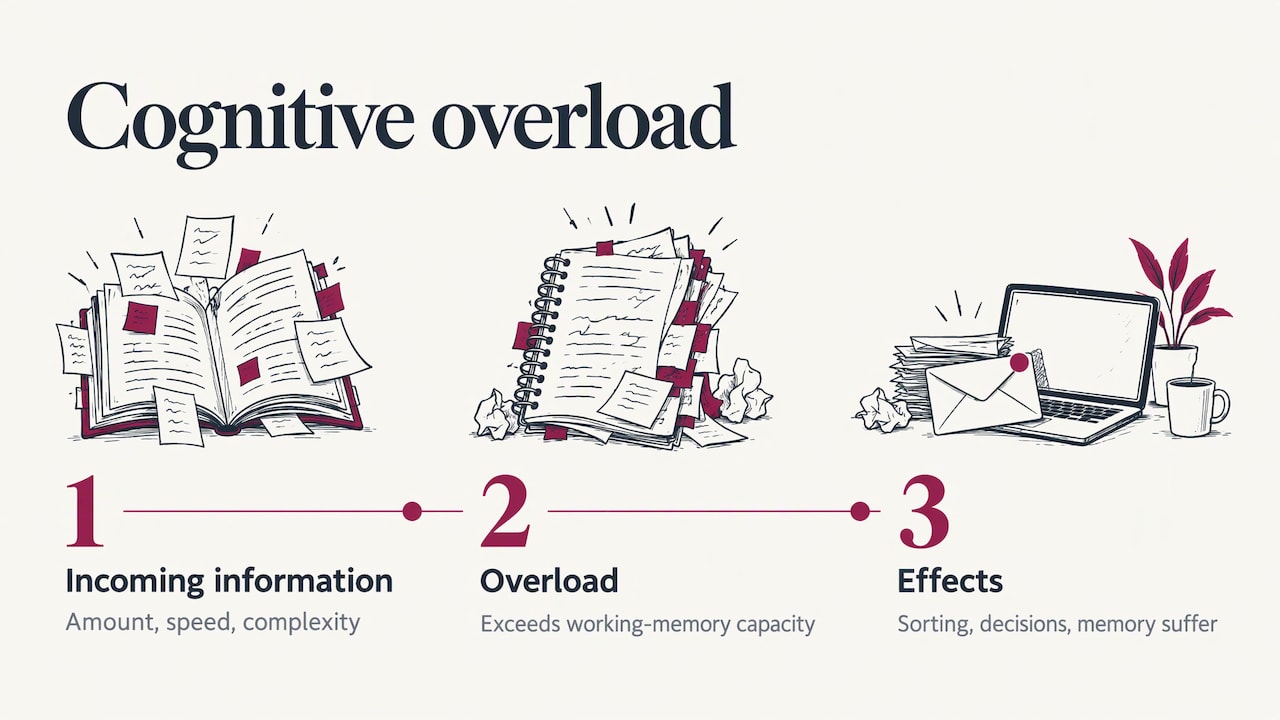
- Cognitive overload means the amount, speed or complexity of what you are taking in has passed what your working memory can handle, so thinking, deciding and remembering get harder.
- Stress and anxiety shrink the room you have, so the same workload feels heavier on a bad week.
- Fast relief: pick two priorities, silence inputs, work in a 25-minute block, then take a real break.
- Lasting relief: sleep 7 or more hours, move daily, take regular breaks from news and screens, and support your nervous system.
- If concentration problems last two weeks or more, or change suddenly, see a primary care provider.
Table of Contents
- What cognitive overload actually is
- Why stress makes overload worse
- A 10-minute reset for when you are overloaded right now
- Reduce the load: changes to inputs and habits
- Recover your capacity: the body-side basics
- Where PRESENCE fits
- Promo
- Our perspective
- When overload is a reason to see a professional
- A simple week-one plan
- FAQ
- Sources
What cognitive overload actually is
Working memory is the mental scratchpad you use to hold a few things at once: a sentence you are reading, the three steps of a task, the number someone just told you. It is small by design. Cognitive load theory, a research framework from education science, says that when the load placed on working memory exceeds its capacity, learning and performance degrade. A 2025 peer-reviewed article in PMC adds that when working memory faces too much information or unnecessary demands, the result is cognitive overload, and people feel confused and frustrated while motivation drops.
A neuropsychologist at the University of Miami Health System describes the everyday version: when the amount, speed or complexity of incoming information exceeds what you can take in, organize and use, it becomes harder to sort details, connect ideas, make decisions and remember what you just learned.
In practice that looks like rereading the same paragraph, opening a fifth browser tab without finishing the fourth task, forgetting why you walked into a room, or staring at a simple email because you cannot decide how to answer it. It is a capacity problem, not a character problem.
Why stress makes overload worse
Overload is not only about volume. The same CU Anschutz report notes that emotions, stress and uncertainty also add to cognitive load. A worried mind spends part of its limited working memory on the worry.
Research on anxiety points the same way. A 2013 study in Frontiers in Human Neuroscience found that induced anxiety disrupts verbal and spatial working memory, and that spatial working memory suffered regardless of how hard the task was. A 2019 paper in Frontiers in Psychology reviewed work in which stress affected only the more demanding version of an attention task, which fits what most people feel: easy tasks survive a bad day, hard ones do not.
The practical point: you can lower overload from two sides. Reduce what comes in, and strengthen how well your nervous system handles load and recovers from it. Most articles on this topic only cover the first. For the stress side in more depth, see our guide to stress and brain fog.
A 10-minute reset for when you are overloaded right now
When your head is full, do not try to think your way out with more thinking. Remove input first.
1. Stop adding
Close the extra tabs, silence your phone and switch off background TV. Harvard Health suggests removing distractions by turning off the TV, setting up message blockers on your computer and silencing your smartphone. This step costs nothing and usually gives the fastest drop in load.
2. Choose two things
Harvard Health’s advice for a long to-do list is to choose two items and leave the others for another time. Write the two down. Everything else goes on a separate “later” list, so your brain stops trying to hold it.
3. Shrink the first task
Ohio State’s guidance is to break larger tasks into small manageable ones and use tools such as a notebook, calendar, alarms and checklists. “Write the report” overloads you. “Open the document and list five headings” does not.
4. Work one 25-minute block
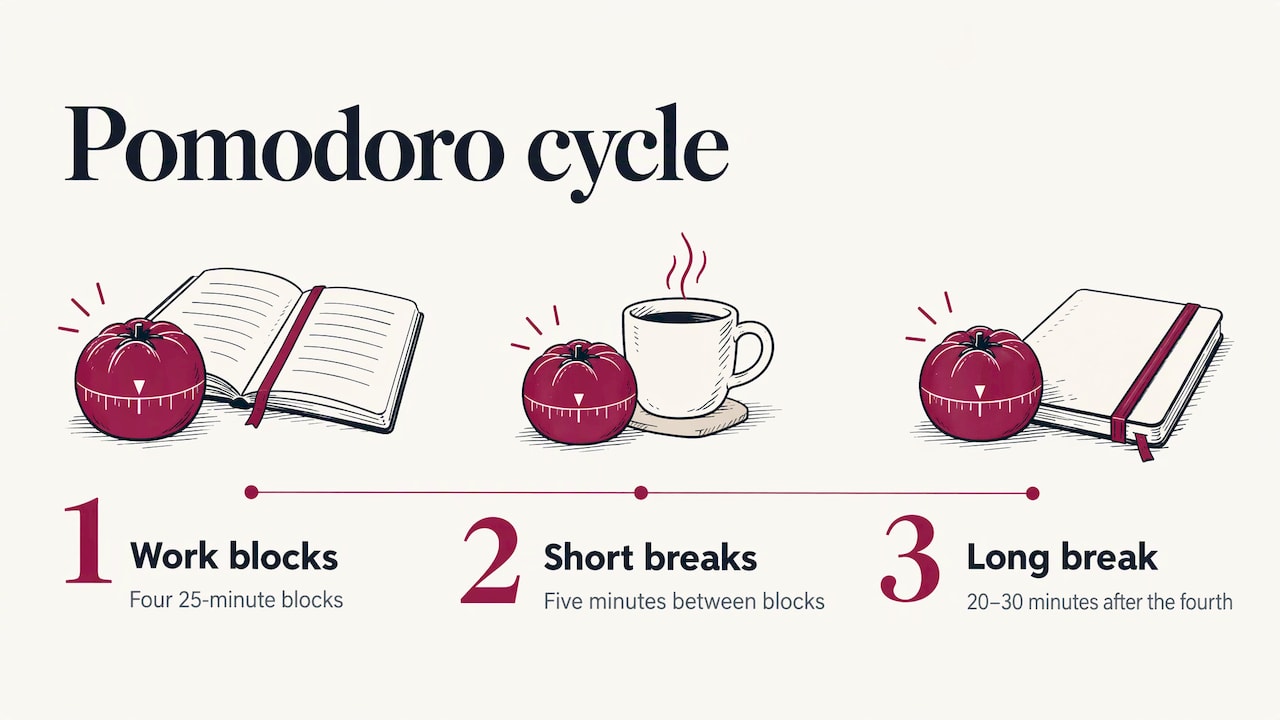
The Pomodoro technique is simple: set a timer for 25 minutes, work straight through, then take a five-minute break. Harvard Health notes that attention can start to wane as soon as 10 minutes into a task, which is why scheduled breaks beat willpower.
5. Make the break a real one
A break is not a social feed. The CDC suggests taking breaks from news and social media and using deep breaths, stretching or meditation to unwind. Stand up, drink water, look out a window and take slow breaths.
If the overload comes with a racing or tense body, our guide to managing overstimulation goes deeper on the in-the-moment side.
Reduce the load: changes to inputs and habits
The reset gets you through the hour. These changes keep you from landing back in the same place next week.
Set priorities before you take in new information
The University of Miami Health System reports that research supports setting clearer priorities before taking in new information, limiting unnecessary inputs, following trusted sources and blocking others, and digesting information rather than reacting to it immediately. In a working day, that means deciding what you need to learn or decide before you open the inbox or the news.
Filter, limit and block
The same source quotes the neuropsychologist recommending stepping away from your phone, computer and TV for a few hours each day. It also says that filtering, limiting and blocking low-value sources can be part of a healthy strategy. Mute the group chat that is never urgent. Unfollow accounts that spike your pulse. Batch email into two or three set times.
Make information easier to organize
Summaries, lists and visuals reduce the work your brain does to structure information. Ohio State adds three memory strategies: repeat important information aloud, turn it into a story, and use chunking to break it into fewer pieces. A phone number is easier as three chunks than ten digits. A meeting is easier as three decisions than forty minutes of talk.
Do one thing at a time
Both Harvard Health and Ohio State advise single-tasking. Ohio State also suggests tackling your hardest tasks at your peak energy time and keeping daily routines at the same time and in the same way, so fewer small decisions compete for attention.
Use the longer Pomodoro cycle
Ohio State describes the full version: four 25-minute work blocks with five-minute breaks, then a longer break of 20 to 30 minutes. If you study or do deep work, this rhythm is easy to keep. For tactics aimed at each setting, see our guides on staying focused at work and staying focused while studying.
Recover your capacity: the body-side basics
A brain that is under-slept, under-fed and never idle has less capacity before the first email arrives. Government health agencies agree on the basics.
| Habit | What the sources say |
|---|---|
| Sleep | The CDC says adults need 7 or more hours per night. NIMH advises sticking to a schedule and reducing blue light before bedtime. |
| Movement | NIMH notes that 30 minutes of walking a day can boost mood. The CDC says to build up to 2 1/2 hours of physical activity a week. |
| Food and water | NIMH recommends healthy, regular meals and staying hydrated. |
| Unwinding | Deep breathing, stretching, meditation, yoga or progressive muscle relaxation, per the CDC and Ohio State. |
| Outdoors and people | The CDC and the University of Miami both list time outdoors and face-to-face connection. |
| Alcohol | The CDC advises limiting it: 2 drinks or less a day for men, 1 or less for women. |
The CDC also points out that small daily steps can have a big impact, and that everyone manages stress differently, so you are looking for the combination that works for you. Pick two rows from the table, not all six. A plan you keep beats a plan you admire.
NIMH also lists journaling, avoiding excess caffeine and challenging negative thoughts in its stress fact sheet. If you feel worn out rather than just full, our mental exhaustion recovery plan and stress recovery plan lay out the steps in order.
Where PRESENCE fits
Habits lower the load. The second half of the equation is the system that carries it. Your nervous system is what lets you stay steady while information keeps arriving, and it recovers or fails to recover depending on how much strain it has absorbed. Our guides on nervous system support and nervous system regulation explain that foundation.
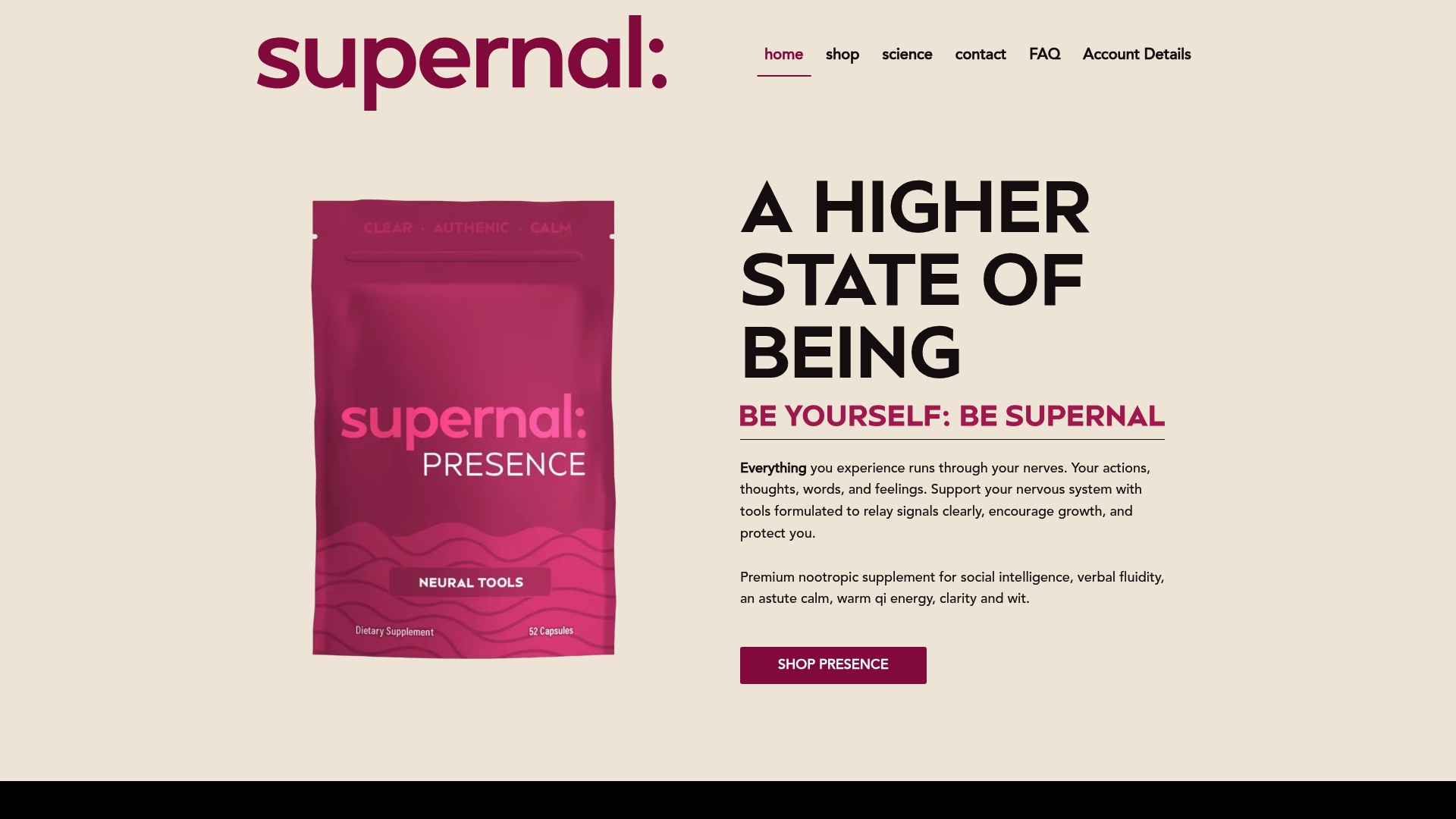
Many people reach for a stimulant when overloaded. More stimulation on top of too much input is the opposite of relief. PRESENCE takes a restorative route: it is a capsule formulated to support neurotransmitter health and resilience against nervous system stress, with a goal of mental clarity and emotional balance rather than a jolt. If you are new to the category, what nootropics actually do and safe nootropics for beginners are the places to start.
Promo
PRESENCE is our restorative nootropic in capsule form, built to support social intelligence, mental clarity and emotional balance without harsh stimulants. It is available as a one-time purchase or a monthly subscription, from $42 per month. Take it alongside the habits above, since the habits reduce the load and PRESENCE supports the system that carries it. You can read the details on the PRESENCE product page.
Our perspective
Most advice about overload treats the brain like an inbox: sort it, trim it, clear it. That advice is right, and we repeat it above. But people who are overloaded rarely lack tips. They lack recovery. A nervous system that has been running hot for months has less room to begin with, so every extra demand tips it over sooner.
That is why we built PRESENCE as a restorative formula instead of a stimulant. Stimulation adds to the load. Our approach is to nurture the nervous system with carefully selected ingredients that support neurotransmitter health and resilience to stress, so clarity and calm can build over time. Our formula is designed to bring improved mental agility within an hour and a stronger nervous system capacity with continued use.
Use it the way you would use any good foundation. Pair it with sleep, movement and fewer inputs, and give it consistency. Overload relief is not one trick. It is a lighter load and a more resilient system working together.
Calvin
When overload is a reason to see a professional
Overload that comes from a heavy week should lift when the week does. Some patterns call for a conversation with a doctor, and that is a sensible step, not a failure.
- Symptoms that last. NIMH advises seeking professional help for severe or distressing symptoms lasting 2 weeks or more, such as trouble sleeping, changes in appetite, difficulty concentrating, loss of interest in things you usually enjoy, inability to complete usual tasks, or irritability and restlessness. Start with a primary care provider, who can refer you to a qualified mental health professional.
- Sudden changes. Harvard Health says to see your doctor if your ability to concentrate changes suddenly, because the cause could be stress, anxiety or depression, a medical condition such as high blood pressure, diabetes or sleep apnea, or mild cognitive impairment.
- Memory trouble. Mayo Clinic advises seeing a healthcare professional if you or a loved one has trouble with memory, since the cause needs to be determined and some conditions behind dementia symptoms can be treated.
- Crisis. If you are in immediate distress or thinking about hurting yourself, call or text the 988 Suicide & Crisis Lifeline at 988, or chat at 988lifeline.org.
A supplement supports everyday mental clarity. It is not a treatment for a medical or mental health condition, so check with your doctor before adding one if you take medication, are pregnant or nursing, or have a health condition.
A simple week-one plan
If you want one concrete plan, use this.
- Day 1: Write today’s two priorities before opening email. Silence notifications for one 25-minute block.
- Day 2: Move your last screen use 30 minutes earlier at night. Aim for 7 or more hours of sleep.
- Day 3: Take a 20-minute walk outdoors, with no podcast or news.
- Day 4: Unfollow or mute three sources that add noise and no value.
- Day 5: Run two Pomodoro blocks on your hardest task at your peak energy time.
- Day 6: Spend time face-to-face with a friend or family member, giving them your full attention.
- Day 7: Review what lowered your load most and keep those two habits for next week.
If you add PRESENCE, start the same week so you can notice how your days feel with consistent support. Our best nootropics for focus and concentration breakdown explains the mechanisms in more detail.
FAQ
How do I get relief from cognitive overload quickly?
Remove inputs first: silence your phone, close extra tabs and pick two priorities. Then work one 25-minute block and take a five-minute break away from screens. Slow breathing or a short walk helps the break do its job.
How is cognitive overload different from stress?
Cognitive overload is about demands on working memory exceeding what it can hold. Stress is your body and mind’s response to pressure. They feed each other: stress and uncertainty add to cognitive load, and overload creates more stress.
Can I reduce cognitive overload long term?
Yes, by lowering the volume of input and building recovery into your routine. That means priorities before information, filtered sources, regular breaks, 7 or more hours of sleep and daily movement. Supporting your nervous system with a restorative formula like PRESENCE fits into that foundation.
How long does it take to recover from cognitive fatigue?
It depends on how depleted you are. A good night’s sleep and regular breaks often make a difference within days, while a long stretch of strain may take longer to unwind. If poor concentration persists for two weeks or more, talk to a primary care provider.
Is PRESENCE a stimulant?
No. PRESENCE is designed as a restorative formula that nurtures the nervous system rather than relying on harsh stimulants. It is available from $42 per month on our product page.
Sources
- CU Anschutz: training and cognitive load theory
- PMC: Application of cognitive load theory
- UHealth: information overload and the brain
- Frontiers in Human Neuroscience: anxiety and working memory
- Frontiers in Psychology: anxiety, stress and cognition
- Harvard Health: pay attention to concentration
- Ohio State: how to improve your memory
- CDC: managing stress
- NIMH: caring for your mental health
- Mayo Clinic: dementia diagnosis and treatment