


How to Stay Focused at Work: 12 Habits That Hold Up
You stay focused at work by doing fewer things at once, removing the interruptions you control, and looking after the body that does the thinking: sleep, movement, breaks and stress. Willpower alone rarely does it. Below are the habits with the best backing, a simple way to build them into a normal workday, and a clear point at which a lack of focus is a reason to see a professional rather than another productivity tip.
TL;DR
- Focus is mostly a design problem: single-task in short blocks, silence notifications, and write down what you still need to do so your head doesn’t have to hold it.
- Sleep (seven or more hours), regular exercise and real breaks do more for concentration than most apps.
- Stress can sharpen you for a deadline, but prolonged stress wears down working memory and performance.
- If trouble concentrating is severe and lasts two weeks or more, talk to a health professional.
- A supplement is a support, not a fix. We explain where PRESENCE fits and where it doesn’t.
Table of Contents
- Why focus slips at work
- Fix the environment first
- Train attention like a skill
- Build the body that focuses
- A workday that puts it together
- What about nootropics?
- Perspective: focus is a nervous system issue
- Where PRESENCE fits
- When poor focus is more than a habit problem
- FAQ
- Sources
Why focus slips at work
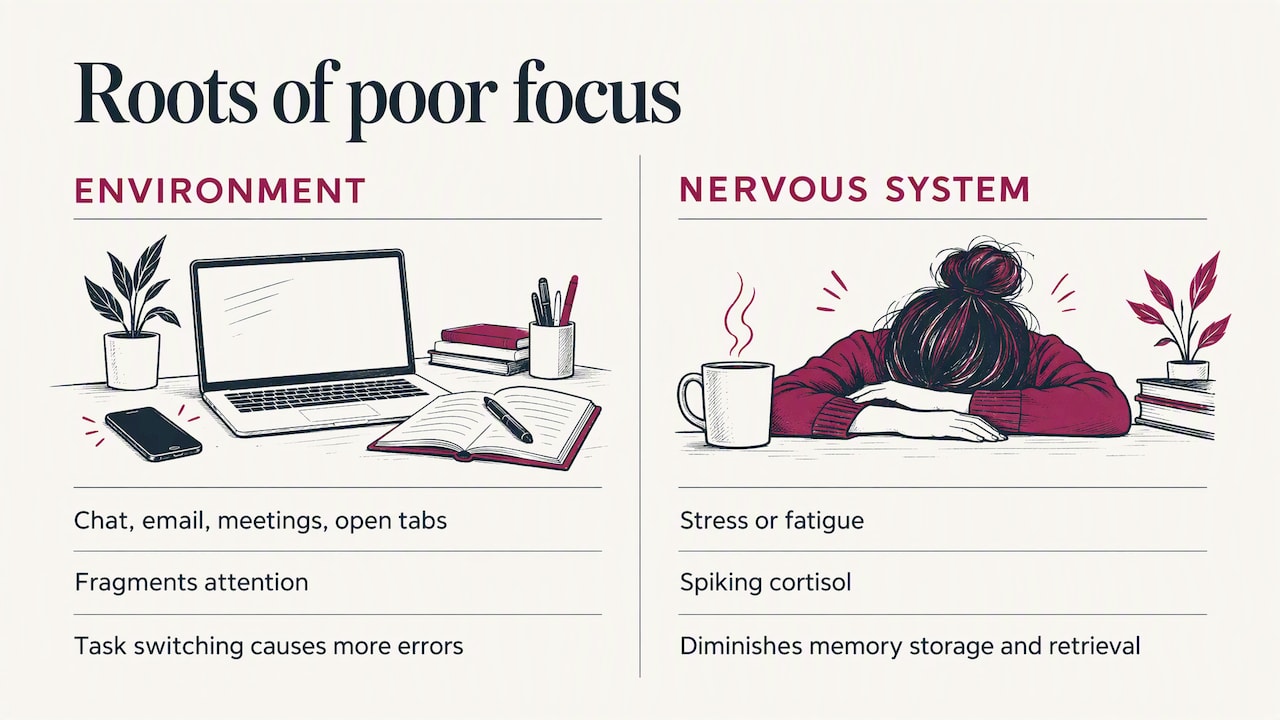
Most workdays are built against concentration. Chat pings, email, meetings and open tabs all ask for a small switch of attention. Asana’s research indicates that 72% of employees feel pressure to multitask, which leads to task switching and more errors. The pressure is real, but the switching is the cost.
Harvard Health describes the mechanism. Monotasking, meaning one job until it is finished, lowers the burden on working memory and reduces vulnerability to distraction. Working memory is the mental scratchpad you use to hold a task in mind. Every switch wipes part of it.
The same Harvard piece adds a body-side factor: spiking cortisol, tied to stress, diminishes working memory storage and retrieval. So poor focus has two roots: an environment that fragments attention, and a nervous system running too hot or too tired to resist it. Good fixes address both.
Fix the environment first
These changes cost nothing and work the same day.
1. Pick one task and finish it
Harvard Health says effective monotasking involves managing time, working for brief periods, blocking distractions and managing stress. Start there. Choose the one task that matters most, set a timer, and treat everything else as a later problem.
2. Name your Most Important Tasks
Asana’s guidance on staying focused recommends setting daily Most Important Tasks (MITs) and timeblocking dedicated focus time. Two or three MITs is plenty. If you finish them, the day was a success, whatever the inbox looks like.
3. Turn off notifications during focus blocks
The same guide suggests creating a distraction-free setup by turning off notifications during work periods. Close the email tab, set chat to “do not disturb”, and put your phone out of reach, not just face down.
4. Try a focus sprint
Asana cites productivity research from UC Berkeley’s Becoming Superhuman Lab finding that teams using “Focus Sprints” reported being 43% more productive. That figure is self-reported, so treat it as encouragement to experiment, not a guarantee. A 25 to 50 minute sprint with a defined goal is a reasonable starting point.
5. Write down what is still open
A running list of everything you still need to do frees your working memory from holding it. Capture stray thoughts in a notepad during a block and deal with them afterward. It takes ten seconds and saves the task you were on.
6. Set boundaries with colleagues
If your job allows it, agree on quiet hours or response windows. OSHA’s guidance for hybrid workplaces suggests employers be upfront about expectations and encourage “quiet hours” when employees turn off email notifications in evenings and weekends. You can borrow the idea for your own working day: tell your team when you are heads-down and when you will answer messages.
Train attention like a skill
7. Practice sustained reading
Harvard-affiliated neuropsychologist Kim Willment suggests a 30-minute reading exercise with a timer to train the brain’s monitoring process, the part that notices when your mind has wandered and brings it back. Read something real, not a feed. When you drift, notice it, return, and keep going. The noticing is the rep.

8. Let boredom happen
Not every pause needs filling. Standing in a queue or waiting for a file to load without reaching for your phone is small, free practice at tolerating a lull. It makes the dull middle of a long task less likely to send you to your inbox.
Build the body that focuses
9. Protect your sleep
NIOSH, part of the CDC, recommends that workers prioritize seven or more hours of sleep, exercise routinely and follow nutrition guidelines to reduce fatigue and manage stress. Research reviewed by NIOSH also suggests that workplace interventions such as physical activity and relaxation approaches may improve sleep. If your focus collapses by mid-afternoon, check your sleep before anything else. Our guide to afternoon brain fog walks through the usual causes.
10. Move on a schedule
The federal Care Navigator recommends 150 minutes of moderate-intensity aerobic exercise per week, which it says increases blood flow to the prefrontal cortex, the region responsible for focus and concentration. That is about 30 minutes, five days a week. A brisk walk at lunch counts.
11. Take real breaks
NIOSH advises employers to consider rest breaks of 10 to 15 minutes, such as every one to two hours during demanding work. A real break means leaving the screen: stand, walk, get water, look out a window. Scrolling your phone is a different kind of input, not rest.
12. Manage stress before it manages you
Stress is not purely the enemy. OSHA notes that workplace stress can prompt workers to stay focused on a task or meet a deadline. The trouble is duration: the same document states that extensive and prolonged stress can harm physical and mental health, reduce productivity and raise the potential for workplace incidents.
The NIH Office of Research on Women’s Health recommends “reframing” as one strategy: deliberately changing how you think about a stressor and how you respond to it. “This meeting is a threat” becomes “this meeting is a problem I can prepare for.” It sounds small, and it is a skill you get better at with repetition.
A workday that puts it together
You don’t need all twelve habits at once. Here is one way to stack the most useful few.
| Time | What you do | Habit it uses |
|---|---|---|
| Start of day | Write two or three MITs; close email | MITs, notification control |
| First block | One task, 25 to 50 minutes, phone out of reach | Monotasking, focus sprint |
| Every 1 to 2 hours | 10 to 15 minute break away from the screen | Rest breaks |
| Midday | Short walk, real lunch | Movement, nutrition |
| Afternoon block | Hardest remaining MIT, notifications still off | Single task, boundaries |
| End of day | List what is open for tomorrow | Offloading working memory |
Pick two rows this week. When they feel automatic, add a third. Habits that stick beat plans that impress.
What about nootropics?
Readers often ask whether a supplement can help with concentration. The honest answer is that it can be a supporting layer, never a replacement for the basics above. If you are sleeping five hours and answering chat every 90 seconds, no capsule will fix that.
If the basics are in place and you want extra support, the type of product matters. Many focus products lean on stimulants, which can leave you wired and then flat. Another approach is to support the nervous system itself. For a deeper look at how different ingredients work, see our breakdown of nootropics for focus and concentration, or start with what nootropics actually do. If you are new to the category, safe nootropics for beginners explains where to begin.
Perspective: focus is a nervous system issue
We built our product around one conviction: the ability to concentrate depends on the state of your nervous system, not only on your discipline. A system that is depleted or over-stressed will lose focus however good your to-do list is. That is why we favor a restorative approach over pushing harder with stimulants.
It is also why we tell people to start with sleep, movement and boundaries. Those habits give your nervous system room to recover. A supplement should work with that process, supporting neurotransmitter health and resilience to nervous system stress, rather than overriding signals your body is sending. If you feel constantly drained, our practical plan on recovering from mental exhaustion is a better first step than any capsule.
— Calvin
Where PRESENCE fits
PRESENCE is our restorative nootropic supplement, taken as a capsule. It is formulated to support neurotransmitter health and resilience against nervous system stress, with the aim of clearer thinking and emotional balance, without harsh stimulants. It is built to be used alongside good sleep and focus habits, and its effects are meant to develop over time.
PRESENCE is available as a one-time purchase or a monthly subscription, from $42 per month. You can read the details on the PRESENCE product page. It is a dietary supplement, not a medication, and it is not intended to diagnose, treat or cure any condition. If you take prescription medicine or have a health condition, check with your doctor or pharmacist before starting any supplement.
If stress is the main thing scrambling your focus, you may also like our guide on calming the nervous system without sedation.
When poor focus is more than a habit problem
Sometimes trouble concentrating is a symptom, not a workflow flaw. The National Institute of Mental Health advises seeking professional help for severe symptoms lasting two weeks or more, including difficulty concentrating or trouble completing tasks.
See a primary care doctor or a mental health professional if:
- Your concentration problems are severe, or have lasted two weeks or more.
- You have physical symptoms alongside them. OSHA lists fatigue, headaches, dizziness and chest pain among the physical signs of critical incident stress. Chest pain or dizziness deserves prompt medical attention.
- Focus problems follow a major event, such as a loss, an accident or a frightening incident at work.
- You have always struggled with attention, in school as well as at work. An evaluation can tell you whether something like ADHD is involved.
If your employer has an employee assistance program, it is often a quick, confidential way to reach a counselor.
FAQ
Why can’t I concentrate at work even when I’m not busy?
The usual suspects are poor sleep, prolonged stress, and an environment full of small interruptions. Check the basics first: seven or more hours of sleep, regular movement, and breaks away from the screen. If it is severe or lasts two weeks or more, talk to a health professional.
How long can I realistically focus at a stretch?
There is no universal number. A 25 to 50 minute block on a single task followed by a short break is a practical starting range, and NIOSH suggests breaks of 10 to 15 minutes every one to two hours during demanding work. Adjust based on how the task feels.
Does multitasking ever help?
For focus-heavy work, rarely. Asana research reports that 72% of employees feel pressure to multitask, which leads to task switching and more errors. Batch small tasks like email into set windows and give demanding work its own block.
Can a supplement help me stay focused?
A supplement can support the foundation, but it cannot replace sleep, movement and fewer interruptions. We designed PRESENCE as a restorative, stimulant-free option for people who already have those basics moving. Talk to your doctor first if you take medication or have a medical condition.
Sources
- The art of monotasking, Harvard Health
- Tips to improve concentration, Harvard Health
- How to Stay Focused in a Distracted World, Asana
- Improving Concentration and Focus, Care Navigator
- Workplace Stress in Hybrid Workforces, OSHA
- Long-term Stress Harms Everyone in the Workplace, OSHA
- Critical Incident Stress Guide, OSHA
- Reducing Fatigue and Stress in the Retail Industry, NIOSH
- Workplace Interventions to Promote Sleep Health, CDC Stacks
- 7 steps to manage stress and build resilience, NIH ORWH
- My Mental Health: Do I Need Help?, NIMH


2 Comments